


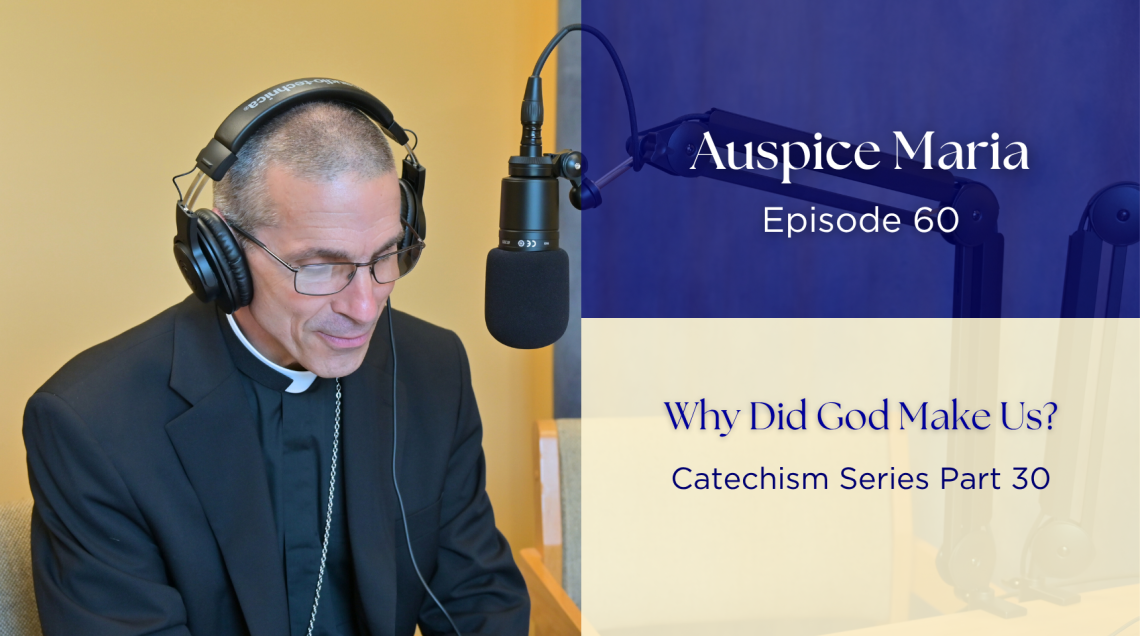
Why Did God Make Us? (Catechism Series Part 30) - Auspice Maria Ep. 60
Follow the Maine Catholic Podcast on:
Transcript:
Welcome back to the Auspice Maria podcast. I'm Bishop James Ruggieri of the Diocese of Portland in Maine.
And this week, we begin part three of the Catechism of the Catholic Church, Life in Christ. But before I do that, again, I'd like to invoke the Holy Spirit for guidance and inspiration, for me and for all who are listening to this podcast, may it be a blessing for all of us as we grow deeper in our appreciation and understanding of our beautiful Catholic Christian faith.
In the name of the Father, and of the Son, and of the Holy Spirit, amen. O gracious God, send forth your Holy Spirit, inspire this podcast, inspire all who listen to it. Help us to grow in appreciation for the beautiful call to beatitude that you have given to each of us. And may we strive together and help each other in this journey of holiness. Please inspire and bless us, Lord. We ask all this through Christ our Lord. Amen.
So, as I mentioned, we begin part three of the Catechism of the Catholic Church, Life in Christ. In part one, we considered what we believe. Part two, we considered how the mystery of Christ is celebrated in the liturgy and the sacraments. Now part three asks how those who have been created by God, redeemed by Christ, and sanctified by the Holy Spirit are called to live.
The paragraphs for this episode are paragraphs 1691 to 1876. And they introduce section one, "Man's Vocation, Life in the Spirit," and take us through chapter one, "The Dignity of the Human Person."
A familiar answer from the Baltimore Catechism about why God made us gives us a simple doorway into this entire section. And that answer is, according to the Baltimore Catechism, "God made me to know him, to love him, and to serve him in this world, and to be happy with him forever in heaven."
That answer is brief, but tells the story of the human person. We come from God, we are made for God, we are called to live with God now, and our final fulfillment is eternal communion with Him.
The Catechism of the Catholic Church begins part three by quoting the words of St. Leo the Great: "Christian, recognize your dignity."
So the moral life begins there. It does not begin with fear or with a list of prohibitions. It begins with the gift of who we are. We are created in the image and likeness of God. Through baptism, we are incorporated into Christ and his body, the Church. Through the sacraments and prayer, we receive the grace of Christ and the gifts of the Holy Spirit, which enable us to live a life worthy of the Gospel.
Humanity's first sin ruptured our original communion with God and wounded human nature. Our minds were darkened, our wills weakened, and our desires unfortunately disordered. But God did not abandon us; through the death and resurrection of Jesus, the way to the Father has been opened.
In Christ, we are reconciled, we are restored, and given grace to live as children of God. This is important because Christianity is not a program of self-improvement by which we climb to God through our own effort. God comes to us first. He creates us. He calls us. He redeems us. He forgives us, and He gives us grace. The moral life is our response to that gift.
Our first great truth, then, is that the human person is made for beatitude. The Catechism teaches that the dignity of the human person is rooted in creation in God's image and fulfilled in the vocation to divine beatitude. That's a reference to paragraph 1700.
Again, the Catechism teaches that the dignity of the human person is rooted in creation in God's image and fulfilled in the vocation to divine beatitude. Beatitude means the fullness of happiness found in communion with God. The beatitudes, proclaimed by Jesus in Matthew and in Luke, reveal the path and the promise. Blessed are the poor in spirit, the merciful, the clean of heart, the peacemakers, and those who hunger and thirst for righteousness. That's Matthew, chapter 5, verses 3-12.
The Catechism says, "The Beatitudes respond to the natural desire for happiness." Paragraph 1718
Every human being desires happiness. We seek it in relationships, achievement, possessions, security, pleasure, and recognition. These may be genuine goods, but none can carry the full weight of the human heart. God placed the desire for happiness within us in order to draw us to himself, the one who alone can fulfill it.
The Christian moral life, therefore, is not the suppression of happiness. It is the purification of our desires so that we seek true happiness. Jesus does not call us away from joy. He leads us toward the joy for which we are made. But the journey requires freedom.
God does not force us to love him. He gives us reason and free will. The Catechism says that by free will, a person shapes his or her own life, and that freedom reaches its perfection when directed toward God, our beatitude. It's a reference to paragraph 1731.
Freedom is not simply the ability to do whatever we want. It is the power to choose what is true and good. And a quote from the Catechism, paragraph 1733: "The more one does what is good, the freer one becomes."
So sin often presents itself as freedom, but it eventually narrows the heart. A lie creates the need for another lie. Resentment hardens into bitterness. Self-indulgence can become slavery. Repeated choices for the good, however, enlarge our capacity to love.
Freedom also carries responsibility. We are responsible for our actions to the extent that they are voluntary, though ignorance, fear, coercion, habit, psychological conditions, and social pleasures may lessen or even remove responsibility in particular cases. These are paragraphs 1734 and 1735.
So the Church takes both objective truth and the person's concrete circumstances seriously. Our choices matter because they shape not only what we do, but who we become. The Catechism teaches that the morality of a human act depends upon the object chosen, the intention, and the circumstances. It's from paragraph 1750.
A good intention cannot make an intrinsically evil act good, meaning an act that in and of itself is just evil. No good intention can make an evil act good. The end does not justify the means. Circumstances can increase or diminish responsibility, but they cannot transform an evil act into a good one.
So our feelings also belong to the moral life, but feelings alone do not determine what is right. The Catechism says, "In themselves, passions are neither good nor evil." That's from paragraph 1767.
Fear, anger, desire, sadness, and joy are part of human life. They become morally significant as they are guided by reason and will. Grace does not erase our emotions. It heals and orders them toward the good.
And importantly, to choose well, we need conscience. Conscience is not simply a private feeling or permission to do what we prefer, often described especially by young people, children, as that voice, that inner voice that speaks to us. But delving more deeply, it is a judgment of reason by which we recognize the moral quality of a concrete action, from paragraph 1778.
And quoting the Second Vatican Council, the document Gaudium et Spes, "The Church in the Modern World," section 16, about conscience, the Catechism says, "His conscience is man's most secret core and his sanctuary. There he is alone with God, whose voice echoes in his depths."
Because conscience is so important, it must be formed. A sincere conscience can still be mistaken. Its formation is a lifelong task, though, involving the word of God, prayer, examination before the cross, the Holy Spirit, wise counsel, and the authoritative teaching of the Church. We must not only ask, what do I feel? But we really should ask, what is true? What is good? What has God revealed?
And the Christian life also requires virtue. The Catechism defines virtue as "an habitual and firm disposition to do the good." That's paragraph 1803.
Virtue is formed through repeated good actions until choosing the good becomes more stable and joyful. The cardinal virtues are prudence, justice, fortitude, and temperance. They help us discern wisely, give what is due, persevere in difficulty, and they govern our desires.
But Christian life cannot be reduced to human effort. God infuses the theological virtues of faith, hope, and charity. And I cite paragraphs 1812, 1813, and the following.
Faith unites us to God's truth. Hope directs us toward eternal life. Charity enables us to love God above all things and our neighbor for God's sake. Charity gives life and unity to all the virtues.
All of this helps us understand why sin is so serious. Sin is not merely breaking an arbitrary rule. Catechism says, paragraph 1849, "Sin is an offense against reason, truth, and right conscience. It is failure in genuine love for God and neighbor."
So sin turns us away from the communion for which we were made. It wounds the sinner, harms others, and weakens human solidarity. Repeated sin produces vice, darkens our conscience, and inclines us toward further sin.
Mortal sin destroys charity through grave matter, full knowledge, and deliberate consent. Venial sin does not destroy the covenant with God, but it wounds charity and hinders spiritual growth. I refer you to paragraphs 1855 to 1864 for these topics of sin, mortal sin, venial sin.
Yet the Catechism does not speak about sin in order to leave us in fear. It speaks of sin within the revelation of mercy. "The gospel is the revelation in Jesus Christ of God's mercy to sinners." Paragraph 1846.
In the passion of Christ, we see both the terrible reality of sin and the greater power of divine mercy. So this brings us back to the question, why did God make us? God made us for communion with himself. Christ has opened the way. The Holy Spirit strengthens us. The sacraments nourish and restore us. But our freedom matters. Our choices matter.
Our habits matter. The way we treat others matters. We do not earn salvation by our own strength. Salvation is grace, but grace does not bypass our freedom. It heals, elevates, and invites our cooperation. The Christian moral life is the life of a child who has received a great inheritance and is learning to live according to it.
So let us ask, what am I becoming through the choices I make? What habits are forming my heart? Is my conscience being shaped by Christ or merely by the surrounding culture? Am I using my freedom to love, or allowing sin to make me less free?
The answer of the Baltimore Catechism remains clear. We were made for God. Every act of faith, every choice for truth, every work of mercy, every refusal of sin, and every effort to grow in virtue is part of the journey toward the happiness for which we were created, to be with God forever in heaven.
Thank you for listening to the Auspice Maria podcast. And as always, I'd like to conclude by just offering a prayer to our Blessed Mother Mary for her intercession and her loving protection.
Hail Mary, full of grace, the Lord is with thee. Blessed art thou amongst women, and blessed is the fruit of thy womb, Jesus. Holy Mary, Mother of God, pray for us sinners, now and at the hour of our death. Amen.