


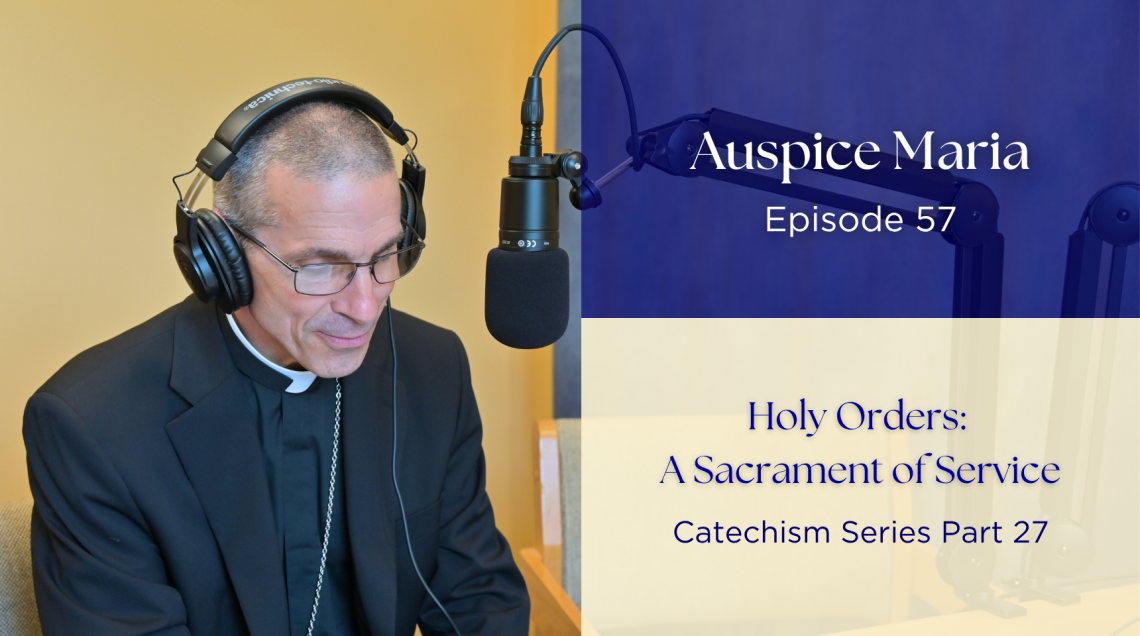
Holy Orders: A Sacrament of Service (Catechism Series Part 27) - Auspice Maria Ep 57
Follow the Maine Catholic Podcast on:
Transcript:
Welcome back to the Auspice Maria podcast. I'm Bishop James Ruggeri of the Diocese of Portland in Maine. And this week, we'll be talking about the sacrament of holy orders in service for the communion of the church.
We're moving into another category of sacraments, sacraments of service to the body. And these two sacraments, as traditionally categorized, are holy orders and holy matrimony.
But before we start again, it's always important to invoke the Holy Spirit's presence and power and inspiration for everyone involved in this podcast, all the listeners, for me, for everyone. So we pray:
Holy Spirit, come to us, fill our hearts, open our minds, and continue to bear that wonderful fruit within us and through our lives. May we be those faith-filled witnesses that by baptism we are called to be. We ask all this through Christ our Lord. Amen.
So in this episode, as I said at the top of the podcast, we move into a new chapter in part two of the Catechism of the Catholic Church. We have reflected on the sacraments of Christian initiation: baptism, confirmation, and the Eucharist. We have also reflected on the sacraments of healing: penance and reconciliation, or the sacrament of confession, and the sacrament of holy anointing, the anointing of the sick.
Now we begin chapter three, the sacraments at the service of communion. There are two sacraments in this category: holy orders and matrimony. The catechism teaches that these sacraments are "directed toward the salvation of others." That's from paragraph 1534. And also, if you're following along in the text, we'll be talking about paragraphs 1,533 to 1,600.
But starting in this area of holy orders and holy matrimony, this category, again, these two sacraments, as the Catechism instructs, are directed towards the salvation of others. They certainly sanctify the one who receives them, but they do so by placing that person at the service of others. Holy Orders serves the people of God through teaching, sanctifying, and governing. Holy Matrimony serves communion through the faithful and fruitful love of husband and wife.
So in this episode, we will consider the Sacrament of Holy Orders. The Catechism says, "Holy Orders is the sacrament through which the mission entrusted by Christ to his apostles continues to be exercised in the Church until the end of time." It's from paragraph 1536.
This is the heart of the sacrament. Holy Orders is not a merely human appointment. It is a sacrament of apostolic ministry. Through it, Christ continues to give his church bishops, priests, and deacons for her life, communion, and mission.
Before speaking about the ordained priesthood, we must remember the common priesthood of all the baptized. By baptism, all the faithful share in Christ's priestly, prophetic, and kingly ministry. Every baptized person is called to offer his or her life to God, to bear witness to Christ, and to participate in the Church's worship and mission.
Quoting the Second Vatican Council, the catechism teaches that "the common priesthood of the faithful and the ministerial or hierarchical priesthood are ordered one to another, and yet they differ from one another in essence and not only degree." This cites a reference to Lumen Gentium, chapter 10, again, that great document on the constitution of the church.
And the ministerial priesthood, again, exists to serve the common priesthood. The ministerial priesthood is not given for privilege, for status, or separation from the people of God. It is given so that Christ may continue to teach, sanctify, and shepherd his people through ordained ministers.
This ministry, ordained ministry, is rooted in scripture and apostolic practice. In the New Testament, the laying on of hands is an important sign of blessing, mission, and transmission of ministry. In Acts of the Apostles, the apostles pray and lay hands on the seven chosen for service — those we recognize as, really, the selection of the first deacons. And amongst those first seven are two of the more well-known ones, Stephen, the first adult martyr in the Church, and Philip. That's from Acts 6, verses 1 to 6.
And later, in the mission of Barnabas and Saul, the church at Antioch prays, fasts, lays hands on them, and sends them forth. That's from Acts 13, verses 2 to 3. And St. Paul will remind his faithful disciple Timothy not to neglect the gift he received "with the imposition of hands by the presbyterate." 1 Timothy 4, verse 14. And also in 2 Timothy, St. Paul tells Timothy to "stir into to flame the gift of God that you have received through the imposition of my hands." 2 Timothy 1, verse 6
These scripture references matter because Holy Orders is not self-appointment. No one simply takes this ministry for himself. The Church calls, discerns, prays, and ordains. The ordained ministry is handed on within the apostolic Church through the laying on of hands and the prayer of consecration.
And the Catechism teaches that Holy Orders has three degrees: episcopacy, presbyterate, and diaconate, from paragraph 1554.
Bishops receive the fullness of the sacrament of Holy Orders. By Episcopal consecration, they are successors of the Apostles and members of the Episcopal College. The Catechism, citing the Second Vatican Council, teaches that "Episcopal consecration confers the offices of sanctifying, teaching, and ruling." It's a citation from Lumen Gentium, section 21, paragraph 1558 of the Catechism.
So the bishop is the visible source and foundation of unity in his particular church, or also we refer to particular churches as dioceses. Priests or presbyters are co-workers of the bishops. They do not possess the fullness of the episcopal office, but they are united with the bishops in priestly dignity and depend on them in the exercise of their pastoral ministry. The catechism, citing the Second Vatican Council, teaches that priests are consecrated "to preach the gospel and shepherd the faithful, as well as to celebrate divine worship." That's from Lumen Gentium 28, paragraph 1564 in the catechism.
So above all, they exercise their sacred office in the Eucharistic assembly, where they act in the person of Christ and offer the sacrifice of the mass. So the bishop is the successor of the apostles, the head of the local church or the diocese, and the priests are his collaborators. They collaborate together and they serve — these two orders, episcopacy and presbyterate — serve the faithful through teaching, through sanctifying, and through governing.
Deacons, the third degree of holy orders, also receive holy orders, but not for the priesthood. The Catechism says that deacons receive the imposition of hands "not unto the priesthood, but unto the ministry." Paragraph 1569.
So deacons are configured to Christ, who made himself the servant of all. Strengthened by sacramental grace, deacons serve the people of God in the ministry of the liturgy, the word, and charity — in communion, very important, in communion with the bishop and in communion with his priests.
So this distinction matters. Bishops and priests share in the ministerial priesthood of Christ in a sacerdotal, or in other words priestly, way. Deacons share in holy orders as a ministry of service. The church needs both. She needs shepherds who preach, sanctify, and govern. She also needs ordained servants who make visible Christ the servant.
Just a word too about deacons. So there are transitional deacons, who are men who have taken a promise of celibacy, meaning they will not marry in the course of their lifetime. Transitional deacons are on the path of ordination to the priesthood, or they're in formation to be ordained priest at some point.
Permanent deacons are men who are ordained and, at the time of their ordination, may be married or single. Permanent deacons are ordained understanding that they will remain deacons for the remainder of their earthly life. So it's interesting, the permanent diaconate was restored with the Second Vatican Council. And as we know very well in our Diocese of Portland, Maine, permanent deacons serve the church very generously and very importantly.
So I want to come back to Holy Orders again, just some general things. How is the sacrament celebrated? The essential rite for all these degrees consists in the bishop's laying on of hands upon the head of the ordained and the specific consecratory prayer asking God for the outpouring of the Holy Spirit and the gifts proper to the ministry. From the Catechism, paragraph 1573.
This simple gesture, laying on of hands, accompanied by the consecratory prayer — this simple gesture carries immense meaning. A man kneels, the bishop lays hands in silence, the church prays, the Holy Spirit acts, and Christ gives a servant to his church. Incredible.
Only bishops validly confer the sacrament of holy orders because they are successors of the apostles and have received the fullness of the sacrament, in paragraph 1576. And this is another expression of apostolic succession. The ministry of the church does not begin with personal ambition. It comes from Christ through the apostles and their successors.
Now, who can receive holy orders? The catechism states, "Only a baptized man validly receives sacred ordination." That's from Paragraph 1577 and it cites a canon in the code of canon law, canon 1024.
Importantly, this teaching is not presented as a judgment on dignity or holiness. Women and men are equal in baptismal dignity and in the call to holiness. The Church teaches that she, the Church, is bound by the choice of the Lord Jesus, who chose men to form the College of the Twelve, and by the apostolic practice that followed.
And St. John Paul II, during his pontificate, reaffirmed that the Church has no authority to confer priestly ordination on women. So this must be taught with clarity and also reverence, and I again draw your attention to paragraph 1577.
The Church's teaching on holy orders is not a denial of the gifts, intelligence, leadership, holiness, or indispensable service of women in the church. It is a statement about sacramental sign and apostolic tradition. The ordained priest acts sacramentally in the person of Jesus Christ, the head and bridegroom of the church.
Finally, Holy Orders imprints a sacramental character. Like baptism and confirmation, it cannot be repeated. The Catechism says that this sacrament "configures the recipient to Christ by a special grace of the Holy Spirit, so that he may serve as Christ's instrument for his church." It's from paragraph 1581.
Because it imprints an indelible spiritual character, a validly ordained man remains ordained forever. You may have heard that beautiful line which quotes Melchizedek, or the reality of Melchizedek, this mysterious figure of the Old Testament in the Book of Genesis who appears and sort of disappears as sort of this type of priest that we know today, the priest of Jesus Christ, he is the eternal high priest.
And Melchizedek in the Old Testament, again, this mysterious figure to whom Abraham gives a tenth of his war booty, he comes and he goes. And so there's no talk of his death. So he becomes, again, this type of the eternal priesthood that really, in the New Testament, we know Jesus to be. And you may have heard again that line, "You are a priest forever in the line of Melchizedek."
So a validly ordained man remains ordained forever. The grace of holy orders obviously does not make a man perfect. The church has always known the weakness of her ministers, but the efficacy of the sacrament ultimately depends on Christ, not on the personal holiness of the minister. It's from paragraph 1584. Now, this should make ministers humble, not complacent. It should also remind the faithful that Christ remains faithful to his church.
Holy Orders is a sacrament at the service of communion. It exists so that the people of God may be taught by the Word, sanctified by the sacraments, gathered in unity, and sent in mission. In bishops, priests, and deacons, Christ continues to serve His Church. He shepherds, He feeds, He forgives, He teaches, and He sends. At the heart of holy orders is not power, but service; not self-promotion, but communion; and not personal status, but Christ, who came not to be served, but to serve.
Thank you so much for listening to the Auspice Maria podcast. And as always, I just would like to end with a prayer to Mary, Mother of all priests, as we pray:
"Hail Mary, full of grace. The Lord is with thee. Blessed art thou amongst women, and blessed is the fruit of thy womb, Jesus. Holy Mary, Mother of God, pray for us sinners now and at the hour of our death. Amen."