


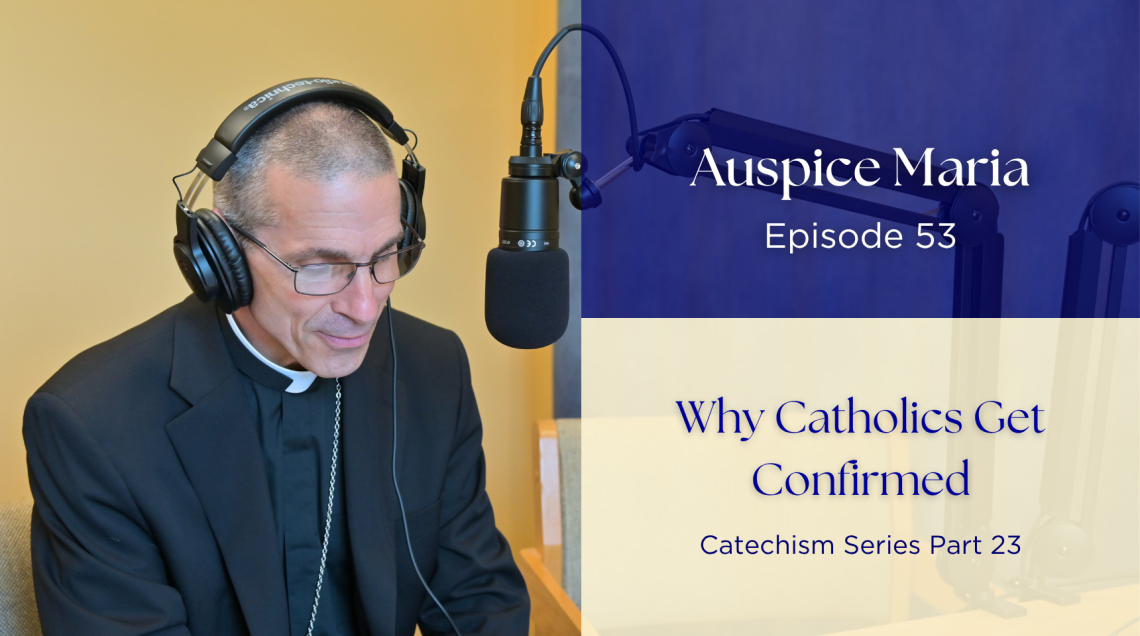
Why Catholics Get Confirmed (Catechism Series Part 23) - Auspice Maria Ep. 53
Follow the Maine Catholic Podcast on:
Transcript:
Welcome back to the Auspice Maria podcast. I'm Bishop James Ruggieri of the Diocese of Portland in Maine. And we continue our series on the catechism, specifically this week talking about the sacrament of confirmation. And as always, I'd like to begin with a prayer, but especially this week invoking the Holy Spirit to inspire us, to help us, to open our hearts to the beauty of this faith that we are so privileged to share. Let us pray.
In the name of the Father and of the Son and of the Holy Spirit. Amen. Come Holy Spirit, fill the hearts of your faithful, enkindle in them the fire of your love. Send forth your spirit and we shall be created and you shall renew the face of the earth. Amen. In the name of the Father and of the Son and of the Holy Spirit. Amen.
So in this episode, again, we continue our journey through part two of the Catechism of the Catholic Church, the celebration of the Christian mystery. More specifically, we are in section two, and our focus is now the seven sacraments of the Church, where in chapter one talks about the sacraments of initiation, specifically article two, the sacrament of confirmation. Basically, we're in paragraphs 1,285 to 1,321.
Just for review, the Church celebrates seven sacraments: baptism, confirmation, Eucharist, penance, anointing of the sick, holy orders, and matrimony.
These sacraments are commonly grouped in three ways: the sacraments of Christian initiation, sacraments of healing, and the sacraments at the service of communion and mission. Baptism, confirmation, and the Eucharist are the sacraments of initiation. Together, they establish and deepen our life in Christ and in the Church.
In our last episode, we reflected on baptism, the gateway to Christian life. Baptism frees us from sin, makes us adopted sons and daughters of God, incorporates us into the life of the Church, into the Church, actually, and marks us with an indelible spiritual character.
Now I'd like to turn specifically to confirmation, which completes and strengthens baptismal grace. The Catechism begins in this section in paragraph 1285 talking about some foundational teaching.
Baptism, the Eucharist, and the Sacrament of Confirmation together constitute the sacraments of initiation, something that I've already mentioned, but again, emphasized here in paragraph 1285. And it talks about how the unity of these three must be safeguarded. It then says that confirmation is necessary for the completion of baptismal grace.
Now this is important because confirmation is not Catholic graduation. It is not merely a personal decision on one's part to remain Catholic. And it is not simply a religious coming-of-age ceremony. It really is a sacrament of initiation.
The Catechism, quoting the Second Vatican Council, the document Lumen Gentium, that is the Constitution on the Church, Section 11, teaches that by confirmation the baptized are more perfectly bound to the Church and are enriched with a special strength of the Holy Spirit. Therefore, as true witnesses of Christ, they are more strictly obliged to spread and defend the faith by word and deed.
So this gives us really the heart of the sacrament. Confirmation deepens our belonging to the Church and strengthens us for witness, for mission. The baptized person is not only called to receive the faith, but to live it, profess it, and hand it on.
So confirmation is personal, but it is never private. It really is ecclesial and missionary. The roots of confirmation are found in Scripture. Now, the prophets announced that the Spirit of the Lord would rest upon the Messiah. Jesus, we are told, is conceived by the Holy Spirit. He's anointed by the Spirit at his baptism in the Jordan and led by the Spirit in his mission. At Pentecost, the Holy Spirit is poured out upon the apostles, transforming fearful disciples into courageous witnesses. And after the Pentecost event, Acts of the Apostles tells us in chapter 8 where Peter and John, they go to Samaria and they lay hands on those who had been baptized so that they might receive the Holy Spirit. So from the beginning, the Church understood that the gift of the Holy Spirit belonged to Christian initiation.
Let's talk now about how the Sacrament of Confirmation is celebrated. In the Roman rite, the essential sign is the anointing with sacred chrism on the forehead, together with the laying on of the minister's hand and the words, "Be sealed with the gift of the Holy Spirit." That's right from paragraph 1,300. Sacred chrism is perfumed olive oil consecrated by the bishop. Oil strengthens, heals, and sets apart. In the Bible, we read kings, priests, and prophets are anointed for mission. Jesus himself is the Christ, the Anointed One. In Confirmation, the baptized are more deeply conformed to Christ and strengthened to share in his mission.
The Catechism says, "the effect of the Sacrament of Confirmation is the full outpouring of the Holy Spirit, as once granted to the apostles on the day of Pentecost." That's from paragraph 1302.
The full outpouring of the Holy Spirit.
It then explains that confirmation increases and deepens baptismal grace. It roots us more deeply in divine sonship. It unites us more firmly to Christ, increases the gifts of the Holy Spirit, makes our bond with the Church more perfect, and gives us a special strength of the Holy Spirit to spread and defend the faith as witnesses of Christ, from paragraph 1303.
So confirmation also imprints an indelible spiritual mark. Like baptism, it gives a special character, and like baptism, can be received only once. The confirmed person is sealed with the Holy Spirit, and that seal speaks of belonging, protection, consecration, and mission.
This helps explain why, in the Latin Church, the bishop is the ordinary minister of confirmation. The Catechism says the original minister of confirmation is the bishop. And then it says, in the Latin rite, the ordinary minister of confirmation is the bishop. Those are found in paragraphs 1312 and 1313.
So priests may confirm in certain circumstances, especially in the initiation of adults, the reception of certain baptized Christians into full communion, or in danger of death.
The bishop's role, though, is not merely ceremonial. Bishops are successors of the apostles and possess the fullness of the sacrament of holy orders. And the Catechism teaches that when the bishop confirms, it shows clearly that confirmation unites those who receive it more closely to the Church, to her apostolic origins, and to her mission of bearing witness to Christ. It's found in paragraph 1313.
So in other words, confirmation links us to Pentecost, to the apostles, and to the mission of the Church today.
Well, here in Maine we also speak often about the "restored order" of the sacraments of initiation. And actually since 1997 the Catholic Church in Maine has followed the restored order for children: baptism in infancy, then confirmation and first holy communion in the same mass around the age of reason, often in the second grade.
Now this practice highlights the unity of baptism, confirmation, and Eucharist and restores the Eucharist as the culmination of Christian initiation.
Now, there are real strengths to this practice. It makes clear that confirmation is a gift of grace, not a reward for completing a program. It helps us avoid speaking of confirmation as graduation from religious education or catechesis. And it reminds us that children need the strengthening gift of the Holy Spirit, not only later in adolescence, but as they begin to live the faith consciously.
There are also pastoral challenges. When confirmation is received at a younger age, some families may mistakenly think that formation is finished. But it is not. Sacramental grace is a beginning and a strengthening, not the end of discipleship. The restored order requires serious ongoing formation after the sacraments. Parents, godparents, sponsors, parishes, and Catholic schools must help children grow into the grace they have received.
So this point is also supported by the Catechism's own warning. It says that although confirmation is sometimes called the sacrament of Christian maturity, we must not confuse adult faith with the adult age of natural growth. That's from paragraph 1308.
A child can truly receive the Holy Spirit, at the same time that child must be accompanied into a mature life of prayer, worship, moral formation, service, and witness.
For those preparing for confirmation, the Catechism says preparation should lead the Christian toward a more intimate union with Christ and a more lively familiarity with the Holy Spirit, his actions, gifts, and promptings, from paragraph 1309.
And this is a strong reminder. Confirmation preparation is not merely information, not merely memorization. It is formation for communion with Christ and mission in the Church. And this is important for adults and older youth as well.
So if you were baptized Catholic but never confirmed, it's not too late. Perhaps maybe your family moved, perhaps formation stopped at some point. Perhaps you drifted from the church. Perhaps no one ever invited you. Well, the invitation remains. The Holy Spirit is not finished with you.
I would simply encourage you, please contact a parish, speak with a priest, a deacon, or a pastoral leader. Ask about preparation for confirmation. What's involved? What's the program like? The church wants to accompany you toward the fullness of Christian initiation.
Confirmation is the sacrament of the Holy Spirit's strengthening gift. It completes baptismal grace. It binds us more closely to the Church. It seals us with an indelible character and sends us as witnesses of Christ.
The same Spirit who descended upon Jesus, the same Spirit poured out at Pentecost, the same Spirit who strengthened the apostles is given to the Church today. In confirmation, that Spirit is given personally and sacramentally so that every baptized person may live more fully as a disciple of Christ and a witness to the Gospel in the world.
Thank you for listening to the Auspice Maria podcast as we've delved this week into the sacrament of confirmation, beautiful sacrament of the fullness of the Holy Spirit. And I would like to just simply end by offering a prayer to our Blessed Mother Mary, the spouse of the Spirit.
Mary, who cooperated with the Spirit as the Spirit overshadowed her, let us pray, asking our mother to pray for us, pray for our local church of the Diocese of Portland, pray for our parishes, our families, pray for our youth. Pray for our children who are perhaps in sacramental preparation now.
As we pray, Hail Mary, full of grace, the Lord is with thee. Blessed art thou amongst women, and blessed is the fruit of thy womb, Jesus. Holy Mary, Mother of God, pray for us sinners now and at the hour of our death. Amen.