


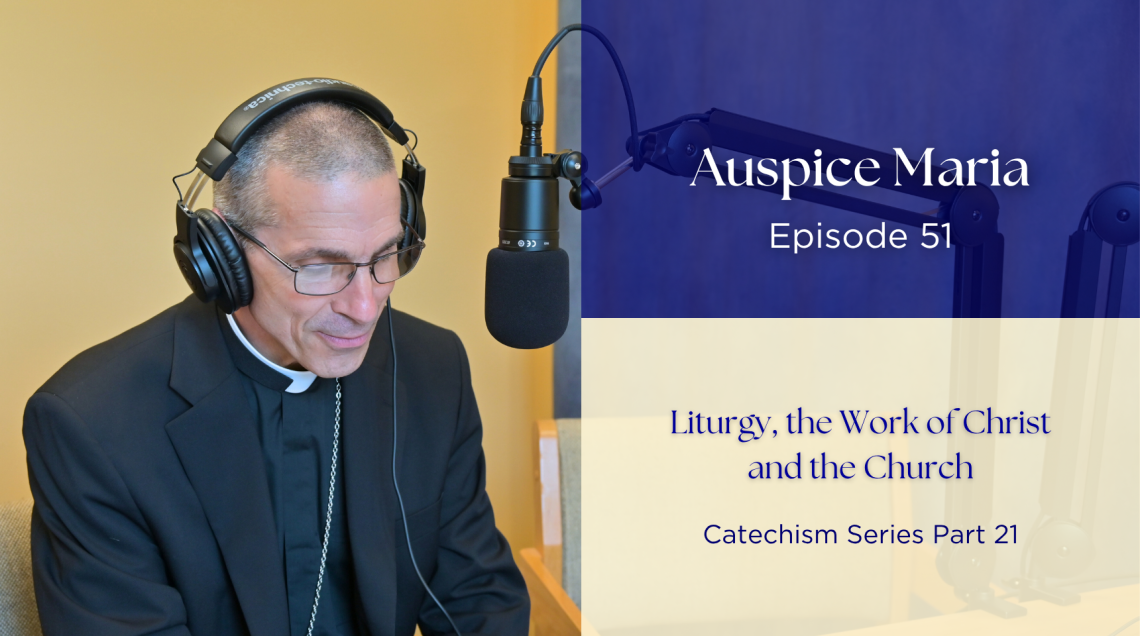
Liturgy, the Work of Christ and the Church (Catechism Series Part 21) - Auspice Maria Ep 51
Follow the Maine Catholic Podcast on:
Transcript:
Welcome back to the Auspice Maria podcast. I'm Bishop James Rugiri of the Diocese of Portland in Maine. And we are continuing with our series on the Catechism of the Catholic Church. We've moved now into the second part of the Catechism about worship, liturgy, sacraments. And I'd like before beginning, of course, to start with a prayer asking for the help of the Holy Spirit to inspire this podcast and all who may listen to it, may it somehow bless us all. In the name of the Father and of the Son and of the Holy Spirit, amen. O gracious Father, we thank you for this privilege of delving more deeply into the sacred liturgy, the work of the Church, and hopefully through our participation, Lord, in this delving deeper, this deep dive, or somewhat deep dive, we may indeed appreciate more the great work of Christ, saving death and resurrection. We ask all this through Christ our Lord. Amen.
Well, again, in our last episode, we began delving more deeply into part two of the Catechism, the celebration of the Christian mystery. We reflected on the meaning of liturgy in the sacraments. Now, liturgy is not simply ceremony. It is not merely a gathering of people who remember Jesus. The liturgy is the work of Christ and the work of the church joined to him. It is the celebration and sacramental communion of the paschal mystery, the passion, death and resurrection and ascension of the Lord. The Catechism taught us that the liturgy is the participation of the people of God in the work of God. That's from paragraph 1069. And that through the liturgy Christ continues the work of our redemption in with and through his church. Again, reference to paragraph 1069.
Now, this is a difficult concept, but with faithful repetition, which I believe in very firmly, faithful repetition, we can begin to see its depth and beauty and hopefully appreciate this wonderful work of the church, this work of Christ done in the church, the liturgy. In the liturgy, Christ acts, the church receives, the Holy Spirit makes present the saving work of Christ today.
Now the catechism moves into another set of very practical questions as we continue through part two. Paragraph 1135 says that this catechesis on sacramental celebrations answers four questions. And these are the four questions I will attempt to build this podcast around today. Who celebrates the liturgy? How is the liturgy celebrated? When is the liturgy celebrated? Where is the liturgy celebrated? Those are right in paragraph 1135 again. Those four questions, again, give us the scope and the sequence of this episode.
So first, who celebrates the liturgy? Well, the answer is larger than we first might imagine. The liturgy is not celebrated only by the priest. It is not even celebrated only by the congregation gathered in a church building. The Catechism says, it is the whole community, the body of Christ united with its head that celebrates. That's from paragraph 1140. Then it goes on to quote the Second Vatican Council. Again, this section of the catechism draws importantly from the document, the sacred constitution on the liturgy, sacrosanctum concilium. And this particular quote is from section 26 of sacrosanctum concilium. Liturgical services are not private functions, but are celebrations of the Church, which is the sacrament of unity. This means that every liturgy belongs to the whole Church. The faithful gathered on earth are truly participating. The ordained minister has a distinct role. The readers, servers, musicians, and other ministers have their roles. The assembly itself has a role.
The catechism says that in the celebration, the whole assembly is liturgos. That's a strange word, but liturgos, I'm going to just spell it out. L-E-I-T-O-U-R-G-O-S. So the catechism reminds us that in the celebration, the whole assembly is liturgos, each according to his function in the unity of the Spirit. Each according to his function in the unity of the Spirit. So we all have different roles, but so beautifully different parts, different ways to participate, but we all are called to participate in the liturgy, in the work of the Church.
And the liturgy also importantly opens us to heaven. The Catechism drawing on the Book of Revelation, it makes a very beautiful connection in these paragraphs 1137 to 1138 to the Book of Revelation and some of its vivid, vivid imagery about the heavenly court and heavenly worship. So drawing on this book of Revelation, the Catechism reminds us that Revelation shows us the throne of God, the Lamb who was slain, the heavenly powers, the saints, the martyrs, the mother of God, and the multitude from every nation. But then it goes on to say, in paragraph 1139, it is in this eternal liturgy that the Spirit and the Church enable us to participate whenever we celebrate the mystery of salvation in the sacraments. So when we celebrate the liturgy on earth, we are joined to the worship of heaven. We do not create worship from below. We are drawn into the worship of Christ, the Lamb before the Father.
That's important because when we talked about the church, we also made an important reference back in our section on the creed of how, yes, the church here on earth is one aspect or you could say one part of the family, but the church in heaven is also another very important part of the community, the body of Christ.
So I want to ask a question, though. What about the souls in purgatory? We're often encouraged to pray for the souls in purgatory. How do they fit into all this dynamic of the work or the worship of the church, the heavenly community, the earthly community? What about the souls in purgatory?
Well, in these paragraphs, the catechism speaks most directly about the heavenly liturgy of those who have already entered the kingdom. And the souls in purgatory are not yet enjoying the full vision of God. So we should not simply identify their state with the heavenly liturgy in the same way as the saints in glory. Yet, importantly, they are truly members of the Communion of Saints. Again, the whole reality of purgatory, these souls are going through this state of, or this experience of purgation, an existential experience of purgation to prepare themselves for the glory of heaven. Again, God's grace at work purifying them. So the souls in purgatory are not separated from the church's love. The church prays for them, especially in the Eucharistic sacrifice. We pray for all the dead. So when we speak of the whole church celebrating, we should say this carefully. The liturgy on earth participates in the worship of heaven and at the same time and in the same communion, the church also intercedes for the faithful departed who are being purified.
Next let's move to the question, how is the liturgy celebrated? Catechism answers importantly through signs and symbols, words and actions, song and music, and sacred images. A sacramental celebration is woven from signs and symbols. That phrase woven from signs and symbols is found in paragraph 1145. This is because we are human beings, body and soul. We do not encounter God as disembodied minds. We hear words, we see gestures, we touch water, we smell chrism, oil, and incense. We taste the Eucharistic bread and wine. Creation itself becomes a language through which God speaks and acts. The Catechism says that light and darkness, wind and fire, water and earth, the trees and their fruit speak of God and symbolize both His greatness and His nearness, from paragraph 1147. So creation speaks of God and symbolizes both His greatness and His nearness. Then Christ takes up these signs and gives them their deepest meaning. Above all, the sacraments, and I quote from paragraph 1152, signify and make actively present the salvation wrought by Christ.
The liturgy is also celebrated through words and actions. The Catechism says the sacramental celebration is a meeting of God's children with their father in Christ and the Holy Spirit. That meeting takes the form of a dialogue. God speaks through his word. The church answers in prayer, in faith, praise, silence, and sacramental action. Word and sacrament belong together. This is why the Liturgy of the Word is not a preliminary part of the Mass, as though we were simply waiting for the important part to begin. I think that's an important thing to emphasize. Liturgy of the Word is not just simply an appendage of the Mass. It really is integral to the Mass. So therefore, arriving hopefully early to Mass, especially before Mass starts, so that one can be settled and prepared to hear the Liturgy of the Word, to hear the readings proclaimed, is very important because, again, the Liturgy of the Word is not simply a preliminary part. The Catechism says the Liturgy of the Word is an integral part of sacramental celebrations. The word proclaimed awakens faith. The sacrament communicates the grace that the word announces.
The Catechism also speaks of music. Quoting the Second Vatican Council, it says, the musical tradition of the universal church is a treasure of inestimable value. And that's, again, a citation from Sacrosanctum Concilium, section 112. Sacred music serves the liturgy when it is joined to the liturgical action, expressive prayer, when it fosters the participation of the assembly and reflects the sacred character of the celebration. Again, citing Sacrosanctum Concilium, section 112.
Sacred images also have their place. Because the Son of God truly became flesh, Christian faith can use visible images to point us to the invisible mystery. The Catechism teaches that sacred images of Christ, Mary, the angels, and the saints are related to Christ and draw us into the mystery of salvation. It's a reference to paragraphs 1159 to 1162.
Now we move to the third question, third movement of our podcast. When is the liturgy celebrated? The Catechism turns first to Sunday and the liturgical year. The church does not simply mark time. She sanctifies time by remembering and making present the mysteries of Christ. So the church sanctifies time, just doesn't simply mark time, like a calendar, but by making present the mysteries of Christ, the liturgy, the church sanctifies time. Quoting the Second Vatican Council, the Catechism says that the Church celebrates the saving work of Christ throughout the year, especially on the Lord's Day, Sunday, and at Easter, and that in the course of the year, she unfolds the whole mystery of Christ. So the year is like this unfolding of this incredible reality of the Paschal mystery. And that's again, citing Sacrosanctum Concilium, section 102, found in the Catechism in paragraph 1163.
So we can conclude very importantly, something that has been taught really since Easter Sunday, the first Easter Sunday, that Sunday is central. The catechism teaches by a tradition handed down from the apostles, which took its origin from the very day of Christ's resurrection. The church celebrates the paschal mystery every seventh day. Again, a reference to Sacrosanctum Concilium, section 106. So I like to think of it as every Sunday is like a little Easter. Sunday is not only a weekend custom, it is the day of the Lord's resurrection. That's why we call it the Lord's Day. It is the day of the Eucharistic assembly. Of course, our vigil masses are in anticipation of Sunday. So thus at the vigil masses on Saturday evening, we have the readings of Sunday and it does fulfill our obligation to attend Mass, although it's difficult to talk about Mass as an obligation. It's really a privilege to attend.
Well, back to the liturgical year. So the liturgical year then unfolds the whole mystery of Christ. If we think of the seasons that we move through over the course of our liturgical year, Advent, Christmas, Lent, Easter, we celebrate the great feast of Pentecost, we have intermittent periods of ordinary time, and then interspersed throughout the year are feasts of the Lord, the Blessed Mother, and the saints. So the Church does not merely think about these mysteries, she celebrates them so that the faithful may receive their grace.
And then let's talk for just briefly the Liturgy of the Hours. Liturgy of the Hours, prayed by priests, religious, and also many laity, also is a way to sanctify time. Morning, evening, and the hours of the day are taken up into the prayer of Christ through the Psalms, scripture, canticles, and intercession, through the Liturgy of the Hours, the Church joins the unceasing prayer of Christ to the Father. Great, some great paragraphs from paragraphs 1174 to 1178 on the Liturgy of the Hours. Maybe that's something that might interest some of our listeners to explore more deeply. It's a beautiful way to sanctify the day.
Now, fourth, let's move to the question, where is the liturgy celebrated? The new covenant instituted by Christ is not tied exclusively to one earthly place. Jesus teaches worship in spirit and in truth, and that's found right in John's Gospel, chapter four, verse 24. Yet, Christians rightly build churches for divine worship. These buildings are not merely gathering halls. The catechism says that they "signify and make visible the church living in this place, the dwelling of God with men reconciled and united to Christ," paragraph 1180.
In the church, really, everything has meaning. The altar is the center because it is both the altar of sacrifice and the table of the Lord. The tabernacle fosters adoration of the Lord truly present in the Blessed Sacrament. The presider's chair expresses the office of the bishop or the priest. In the cathedral, the chair is called the cathedra. It is the bishop's seat and also symbolic of the bishop's authority to teach, to govern, and to sanctify in that local church. The ambo from which the readings are proclaimed, the ambo expresses the dignity of the word of God. The baptismal font reminds us that the Christian life begins at baptism, and the place of reconciliation, the reconciliation room, the confessional reminds us that this life must be renewed through mercy. Those are again some really great paragraphs from 1182 to 1185.
Finally, the Catechism turns to liturgical diversity, sort of the last part of these paragraphs that I'm addressing today. Liturgical diversity doesn't mean we just kind of do different things, experiment with the liturgy, oh no, not at all. The mystery is one, but the forms of celebration are diverse. Talking about really liturgical rites. The Catechism in paragraph 1200 says, the mystery celebrated in the liturgies won, but the forms of its celebration are diverse. Let me explain that. The church includes different liturgical traditions, Latin, Byzantine, Alexandrian, or Coptic, Syriac, Armenian, Maronite, and Chaldean. And quoting the Second Vatican Council, the Catechism says that the Church holds all lawfully recognized rights "to be of equal right and dignity." And that's again, citing Sacrosanctum Concilium, section four. So the diversity is not division. It is catholicity. The same Paschal mystery is celebrated in different languages, often using different gestures, chants, symbols, and cultures. The church can receive and purify the authentic riches of cultures while preserving the faith and sacramental signs received from Christ and hierarchical communion. So again, we're not talking about, let's experiment with the liturgy here. These are recognized official rights of the church.
So the question, who celebrates? Well, again, this is sort of just like a little review here. Who celebrates? The whole Christ, head and body, the Church on Earth joined to the worship of heaven. And again, to the question, how is it celebrated? Through signs, symbols, words, actions, music, and sacred images. When is the liturgy, the work of the Church celebrated? Above all, on Sunday, throughout the liturgical year and in the daily prayer of the church. Where is the liturgy celebrated? Whenever the church gathers, especially in sacred buildings that make visible the church as the dwelling of God among his people. So the liturgy is not an interruption of Christian life. It is the place where Christian life receives its source. In the liturgy Christ acts, the Spirit sanctifies, the Father is glorified, and the Church becomes more fully what she is, a people drawn into communion with God and sent to live the Gospel in the world.
I'm concluding now, but I just would like to put in a personal, may I say suggestive, recommendation for all of us to recapture the sacredness of the Lord's Day Sunday. I've tried to expound on why Sunday is important as the Catechism expounds on why Sunday is important. Unfortunately, I think in our present day society and culture, Sunday has really lost its significance in the minds and hearts of many. And I think for all of us who really love the liturgy or desire to enter more deeply into communion with Christ and the Church, I think one way to do that, of course, is attending Mass, but also making the Lord's Day truly what it is, a holy day, a day maybe to connect with family or friends, a day to perhaps do something different than the other six. Now I know that sometimes people have to work and I understand that, or there are responsibilities that maybe that's the only day of the week that they can be completed, but I'm just, again, just trying to put in a plug for the sanctification of Sunday, the Lord's Day, and making it a special day as we remember what Christ did for us through his saving life, death, and resurrection.
Well, thank you for joining me for this Auspice Maria podcast. And as always, I just would like to conclude with a prayer to our blessed Mother Mary asking for intercession. Hail Mary, full of grace. The Lord is with thee. Blessed art thou amongst women, and blessed is the fruit of thy womb, Jesus. Holy Mary, Mother of God, pray for us sinners now and at the hour of our death. Amen.