


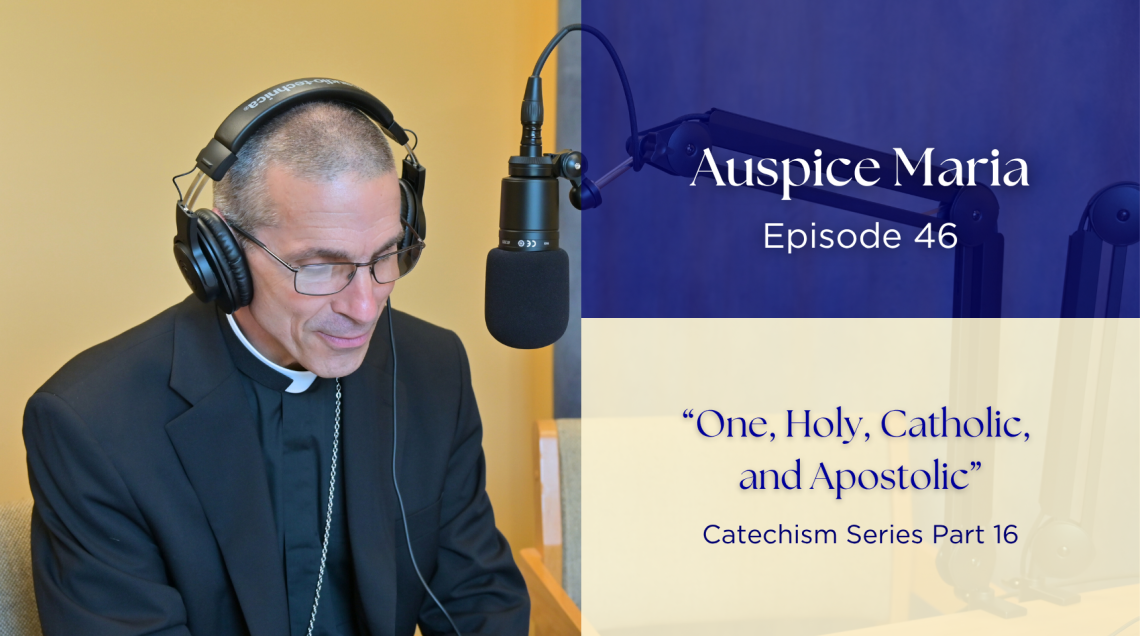
One, Holy, Catholic, and Apostolic (Catechism Series Part 16) - Auspice Maria Ep 46
Follow the Maine Catholic Podcast on:
Transcript:
Welcome back to the Auspice Maria podcast. I'm Bishop James Ruggieri of the Diocese of Portland in Maine. Today I'll be addressing these four marks of the Church, basically paragraphs 811 to 870 of the Catechism of the Catholic Church. And as always, I'd like to just start with a little prayer to the Holy Spirit, asking the Holy Spirit to inspire all those who listen to this podcast and asking the Holy Spirit also for personal inspiration to be open to His promptings and His leadership. So Holy Spirit, come be with us, inspire us, and thank you for the gift of your wisdom and understanding, right judgment. Pray for all those Lord who are listening today, give them your peace. And we ask all this through Christ our Lord. Amen.
Well again, today in this episode we continue our journey through the Creed as presented in the Catechism of the Catholic Church. And I'll be reflecting on the article of faith, "I believe in the Holy Catholic Church." In particular, I'm coming to now the four marks of the Church. One, holy, Catholic, and apostolic. Familiar words to us as we pray the Creed and profess that regularly.
Now these are words many Catholics have said at Sunday Mass. And because they are so familiar to us, it's possible to easily just pass over them or really not ponder them. We can forget that these words are not simply descriptions of an institution. We also hopefully realize they're not slogans, nor are they ideals the Church invented for herself.
The Catechism states this very clearly in paragraph 811, the Church does not possess them, these marks, of Herself. It is Christ who through the Holy Spirit makes His Church one, holy, Catholic, and apostolic.
The Catechism is teaching that the four marks, these four characteristics of the Church, these four marks reveal both the identity and the mission of the Church. So basically they're existential, they're innate, inherent to what the Church is and what the Church is made for.
They tell us who the Church is because they tell us what Christ has made her to be. And that's where I'd like to begin. The Church, firstly, is not something we build. The Church is something that Christ gives. She is born from His saving work. The Church is animated by His Holy Spirit. The Church exists because God desires to restore humanity to communion with Himself.
And if we were to go back to the beginning of salvation history, we remember that the human person was created in the image and likeness of God, those famous words of Genesis chapter 1 verse 27. Humanity was created for communion. holiness, truth, love, and really eternity, eternal life with God. However, sin wounded that original beauty, sin damaged the communion with God that we had with one another also, and even within our own hearts. Sin did not erase the image of God that we're made in, but it really disfigured it. It left the human person divided, weakened, and definitely in need of redemption.
Jesus comes to restore what sin has wounded. In Christ, the image of God is perfectly revealed. He is not only true God, He is also true man. He shows us what humanity is meant to be. Therefore, to become holy is not to become less human, it is to really become more fully human, more fully alive in Christ.
This is why the Church matters. The Church is not merely an association of religious people. She is not simply an institution that preserves Christian values. The Church is the living body of Christ in history. She is the place where Christ continues to teach, to sanctify, to forgive, to heal, to redeem, to gather, and to send His people.
I'd like to now delve into these four marks. First mark, the first one is the Church is one. The Church is one because God's saving plan is one. Sin scatters, Christ gathers. It's kind of a little catchy phrase. Sin scatters, Christ gathers. Sin divides, Christ reconciles.
The Catechism says the Church is one because of her source. And that source is the unity of the Father, the Son, and the Holy Spirit. Church is one because of her founder, Jesus Christ, who reconciled humanity to God by His saving death on the cross and His resurrection. The Church is one because of her soul, the Holy Spirit, who brings about communion among the faithful.
Those remarks were based on paragraph 813 of the Catechism, drawing interestingly from a Vatican II document, Unitatis Redintegratio, which is the Second Vatican Council's decree on ecumenism.
Now, the unity of the Church is not simply administrative unity. It is not merely that Catholics throughout the world belong to the same global organization. The unity of the Church flows from the unity of the Trinity.
The Church is one because, again, God is one and because Christ has one body. The Church is one because the Holy Spirit is the principle of her communion. So at the same time, the Catechism is realistic. This one Church contains great diversity. There are different peoples, cultures, vocations, gifts, offices, and ways of life.
However, diversity does not contradict unity. When rightly ordered, it reveals the richness of unity. What wounds unity is not diversity but sin. And that is important today because we live in a world that can often confuse unity with uniformity or diversity with fragmentation. Like for example, a parish may include long time parishioners, recently arrived persons, young families, college students, older adults, converts, Perhaps cradle Catholics, there might be a priest or two in that parish, maybe religious brothers or sisters, could be a deacon. So unity here does not mean erasing those differences or states of life, but diversity also does not mean each group becomes its own separate church. In Christ, these many gifts are gathered into one body. The Church offers something deeper.
She is called to be a communion where many peoples, languages, cultures, and vocations are gathered into one body by one Lord, one faith, one baptism, and one Holy Spirit. The Catechism also names the visible bonds of this unity. "Profession of one faith received from the apostles, common celebration of divine worship, especially of the sacraments, apostolic succession through the sacrament of holy orders." There's a little bit more to that, but I try to give you the gist. It's paragraph 815. Again, emphasizing the unity of the Church is spiritual, but it is not only invisible, It is doctrinal, it is sacramental, and hierarchical. It is lived in communion with the successor of Peter, the pope, and the bishops in communion with him.
So here we come to an important ecclesiological point. The Catechism quoting Vatican II's document on the Church, Lumen Gentium, section eight, teaches, again, "this Church subsists in the Catholic Church. which is governed by the successor of Peter and by the bishops in communion with him." I'm gonna go back and fill in a little bit. I didn't quote that entirely, but that's paragraph number 816, Lumen Gentium, section eight. This Church, that is the Church that Christ established and entrusted to Peter's care, we see that very clearly in Matthew's Gospel, chapter 16.
This Church that Christ established subsists in the Catholic Church. So this does not mean that Christ is absent from other Christians. It does not mean that grace is absent outside the visible boundaries of the Catholic Church. But it does mean that the fullness of the means of salvation entrusted by Jesus Christ to the Church subsists in the Catholic Church.
The Catechism then holds together truth and charity. So those born into communities separated from full communion with the Catholic Church are not personally charged with the sin of separation. And those justified by faith and baptism are rightly called Christians and accepted as brothers and sisters in the Lord, from paragraph 818. Again, Unitatis Red Integratio.
The Catechism also teaches that many elements of sanctification and truth are found outside the visible confines of the Catholic Church, including the written word of God, the life of grace, faith, hope, and charity. That's drawing from both Lumen Gentium VIII and Unitatis Red Integratio. Section Three, as my last reference was also Section Three of Unitatis, Red Integratio.
I'd like to just say here, this is sometimes referred to as an ecclesiology of elements, meaning there are elements of truth, and as the word sanctification, are found in other churches, other Christian churches. This is really important because it's essential for our work in ecumenism. Ecumenism is basically efforts, prayer, working toward Christian unity. You've maybe heard of the word or the phrase ecumenical dialogue. Christians come together and they talk about things usually in common, trying to find those commonalities as opposed to the things that divide us.
We do not seek Christian unity, though, by pretending differences do not matter. We do not seek unity by minimizing truth, but neither do we deny the real work of grace in other Christians. The word of God, baptism, prayer, charity, the gifts of the Spirit, invisible elements of Christian life, these are real gifts. They come from Christ and they lead back to Christ. So the Church is one. but that unity is wounded. Therefore, the Church must pray and work for the unity Christ wills.
And the Catechism says that the desire to recover the unity of all Christians is, quote, a gift of Christ and a call of the Holy Spirit, close quote. And that's from paragraph 820.
So, in other words, ecumenism, these efforts at Christian unity, ecumenism is not a side project. It belongs to obedience to the prayer of Jesus, that all may be one. But it must always be rooted in conversion, prayer, holiness, charity, and faith.
Second, the second mark, the Church is holy. And again, we have to be careful here. Many people look at the sins of the members of the Church and ask, how can the Church be considered holy as they see the weaknesses of the members of the Church?
That question really must be taken seriously. The sins of Christians, especially when they wound the vulnerable or damaged communion, can never be minimized, yet the holiness of the Church does not come from the moral perfection of her members. It comes from Jesus Christ. And quoting Vatican II, again, Lumen Gentium, this time section 39, Catechism says, "the Church is held as a matter of faith to be unfailingly holy."
That's quite a statement. And we're gonna say, well, why? Well, because Christ loved the Church as His bride, gave himself up for her, sanctified her, joined her to himself as His bride, and endowed her with the Holy Spirit. And all of that comes from paragraph 823.
So the Church is holy because Christ is holy. The Church is holy because the Holy Spirit gives her life. The Church is holy because in her the sacraments are given, the word is proclaimed, and sins are forgiven, and beautifully saints are formed, and the grace of God is poured into human hearts.
But we cannot deny the Church is made up of sinners. The catechism says, the Church on earth is endowed already with the sanctity that is real though imperfect. Paragraph 825 referring to Lumen Gentium 48.
It's a beautiful and honest phrase though, real though imperfect. The Church has some real sanctity in her members, but yet also the reality there is much imperfection. The holiness of the Church is real because again, Christ's grace is real, but it is imperfect in her members. Because let's be honest, we're still pilgrims. We still need all of us. Every single one of us needs conversion. We need God's mercy. We need ongoing purification and renewal.
So this connects directly to the theme of restoration. Christ does not redeem humanity in the abstract. He restores real persons. He heals wounded hearts. He forgives sins. He forms saints. And the saints are the great evidence that the Church is alive with the holiness of Jesus Christ.
And in paragraph 828, citing this work of St. John Paul II, Christi Fidelis Laice, it's a post-synodal exhortation of our late Holy Father on the vocation and mission of the lay faithful in the Church and in the world. It dates from 1988. But in quoting that, Catechism says "the saints have always been the source and origin of renewal in the most difficult moments in the Church's history." And that's really true if we think about the great saints that at least come to mind. They often come on the horizon in times of great difficulty, great trial, and great need.
And this is again vital for us to keep in mind today. Because when we ask how the Church will be renewed, really the deepest answer is not first programs, structures or strategies. Although those can be helpful, the deepest answer is holiness. The Church is renewed when her members become saints or they strive for sanctity. The Church is renewed when Catholics live from the grace they have received. The Church is renewed when we become more deeply conformed to Jesus.
And Mary shows us what this restoration looks like in its perfection. Catechism says that "in the Blessed Virgin Mary, the Church has already reached that perfection, while the faithful still strive to conquer sin and grow in holiness." From paragraph 829, citing again, Lumen Gentium, section 65. In Mary, we see the Church as she is meant to be, receptive to grace, fruitful in obedience, and wholly given to God.
Now the third mark, Catholic. The word Catholic means universal, but not simply in the sense of being widespread. Catechism says that Catholic means, quote, "according to the totality," or another quote, "in keeping with the whole," right from paragraph 830.
So the Church is Catholic first because Christ is present in her. where Christ is present, there is the fullness of His body united with its head. She received from him, quote, "the fullness of the means of salvation." That's from paragraph 830.
Because Jesus is present in His Church, this means though responsibility because if the Church has received the fullness of the means of salvation, she has received them not just for herself but for the world. The Catechism quoting, again, Lumen Gentium, this time section 13 says, "all men," again, a generic word for all people, "all men are called to belong to the new people of God," right from paragraph 831.
So this people of God is to be spread throughout the whole world and through all ages so that God's design may be fulfilled. The Church is Catholic because Christ is for all. His salvation is for all. His truth is for all, His mercy is for all, and His Church is sent to every people, every culture, every language, every age, and every human heart.
And this can really help us understand the relationship between the universal Church and the local church. And the Catechism teaches that the Church of Christ is truly present in legitimate local communities of the faithful, gathered by the preaching of the gospel, the celebration of the Eucharist, and communion with their bishops, right from paragraph 832.
So a diocese is not a branch office of a religious corporation. A diocese is a particular church, a real manifestation of the One Holy Catholic and Apostolic Church when it lives in communion with its bishop and through him with the successor of Peter in the universal Church.
So this has some pastoral consequences. The Church's catholicity is not an abstraction. It has lived in parishes, missions, schools, families, monasteries, hospitals, ministries of charity, and the lives of ordinary believers. The universal mission of Christ becomes concrete in local places. It's kind of beautiful how we all share in the same one mission.
Then the Catechism asks, well, who belongs to the Catholic Church? It quotes Lumen Gentium 13 in its answer, "all men are called to this Catholic unity of the people of God." So all people, all people are called to this Catholic unity.
And then the Catechism teaches that "full incorporation into the Church involves accepting the means of salvation given to the Church, meaning her profession of faith, the sacraments, ecclesiastical governance, and communion." from paragraph 837.
Then comes a sober warning. "One who does not persevere in charity remains in the Church in body, but not in hearts." Again, paragraph 837. It's a great point to ponder that one who does not persevere in charity, love for God, love for a neighbor, One who does not persevere in charity remains in the Church, in body, but not in heart.
So that line really should make me, make all of us pause. It's possible to be visibly inside the Church, a member of the Church, and yet not live from the heart of the Church. It's possible to bear the name Catholic and yet not persevere in charity. Again, love of God and love of neighbor.
So at this point, it's important also to address a phrase that can easily be misunderstood and in fact has caused some problems in the course of history. The phrase is, "outside the Church, there is no salvation." Well, properly understood, this is not a slogan of condemnation for those who are not members of the Catholic Church. It is really a confession of faith in Christ and in the Church as His body.
Catechism explains, "reformulated positively, it means that all salvation comes from Christ the head through the Church which is His body," paragraph 846. In other words, all salvation is through Christ, and Christ has inseparably joined himself to the Church.
At the same time, the Church teaches this with great care and mercy because the Catechism quotes Vatican II's Lumen Gentium section 16, which says, those who, "through no fault of their own," do not know the gospel of Christ or His Church, but sincerely seek God and move by grace, strive to do His will as they understand it through conscience, "may achieve eternal salvation," and that's paragraph 847.
So again, this does not make the Church unnecessary or just one means of salvation amongst others. It does not make evangelization optional. It simply acknowledges that God's grace can work in ways known only to God.
That is why the Catechism immediately adds that the Church still has, "the obligation and also the sacred right to evangelize all men, all people." Paragraph 848.
The possibility that God may save those who are not visibly incorporated into the Catholic Church does not weaken mission, it deepens it, because if Christ is the Savior of all and if the Church has received the fullness of the means of salvation, then love impels the Church, moves the Church to proclaim Jesus Christ, invite people into full communion, and serve the unity of the whole human family.
Fourthly, the Church is apostolic. The Church is apostolic because she's built on the foundation of the apostles, because she preserves and hands on the apostolic faith, and because she continues to be taught, sanctified, and governed through the successors of the apostles, the bishops. In communion with the successor of Peter,
Now again, this matters because apostolic succession is not simply a historical chain of office holders. It is part of Christ's gift to the Church. It protects continuity. It safeguards the apostolic faith. It ensures that the Church is not reinvented in every age according to passing opinion. The Church is living, but she is not self-invented. She receives what she hands on.
And the Catechism says that in the office of the apostles, there's one aspect that cannot be transmitted. They were the chosen witnesses of the Lord's resurrection and the foundation stones of the Church. Those apostles were unique, but their office also has a permanent aspect. Christ promised to remain with them always and therefore, "the apostles took care to appoint successors," paragraph 860, citing Lumen gentium 20.
This is why the ministry of bishops is so important in Catholic ecclesiology. study of the Church. Bishops are not merely administrators, they are successors of the Apostles. In communion with the Pope they serve the unity, holiness, catholicity, and apostolicity of the Catholic Church. They do not own the Church, they receive a ministry of service within the Church, and their task is to guard the deposit of faith, sanctify through the sacraments, govern in charity, and keep the Church faithful to Christ's mission.
The whole Church is apostolic because the whole Church is sent. And the Catechism says, quoting Vatican II's document on the laity, and that's from section four, I cite, "Christ sent by the Father is the source of the Church's whole apostolate." The reference is found in paragraph 864 of the Catechism.
It then teaches that the fruitfulness of all apostolic work depends on vital union with Jesus Christ and that charity drawn above all from the Eucharist is the soul of the whole apostolate. Charity drawn above all from the Eucharist is, "the soul of the whole apostolate," paragraph 864.
Very powerful teaching. The source of mission is Christ. The condition of fruitfulness is union with Christ. The source of apostolic activity is charity. Mission is not simply activism. Mission is not mere productivity. Mission is Christ living and acting in His body through the power of the Holy Spirit for the salvation of the world.
So here we return to the question with which we began. Do we realize what the Church is? Do we realize that the Church is the living instrument by which Jesus Christ continues to redeem humanity? Do we realize that in the Church we are not simply members of an organization but members of Christ's body? Do we realize that our baptism incorporates us into a people called to holiness and sent on mission?
The Catechism's summary is beautiful. The Church is one. She acknowledges one Lord, confesses one faith, is born of one baptism. The Church is holy. The most holy God is her author. The Church is Catholic. She proclaims the fullness of the faith. The Church is apostolic. Christ governs her through Peter and the other apostles who are present in their successors, the pope and the college of bishops.
So finally paragraph 870 brings the teaching together by returning to Lumen Gentium 8, the sole Church of Christ which is in the creed we profess to be one, holy, Catholic, and apostolic, subsists in the Catholic Church. And then it continues, "nevertheless, many elements of sanctification of truth are found outside its visible confines." All that summary can be found in paragraph 870, again, citing Lumen Gentium 8.
That is the balance of Catholic faith, fullness without arrogance, truth without harshness, charity without compromise, ecumenism without relativism, and mission without fear.
So the Church exists because Christ saves. The Church exists because the Father desires all people to be restored in the Son through the Holy Spirit. And the Church exists because humanity is wounded by sin, is called back into communion with God. In that communion, we become holy, we become more fully human, we become what we were indeed created to be.
So when we profess faith in the One Holy Catholic and Apostolic Church, we're not simply reciting an ecclesiological formula. We are confessing the saving work of Christ still alive in history. We are confessing that the Holy Spirit continues to gather, sanctify, teach, and send.
And we are confessing that the Church, despite the weakness and sinfulness of her members, remains the body of Christ, the bride of Christ, the people of God, and the temple of the Holy Spirit.
So perhaps as I end, the real question for us is this. Am I allowing Jesus Christ to restore me through the life of His Church? Am I living as a member of His body? Am I seeking holiness, not as an abstract ideal, but as the restoration of my humanity in Christ? Am I working for unity, living in charity, receiving the sacraments, professing the apostolic faith, and participating in the Church's mission?
So, more than one question, of course, but maybe some things to ponder. Because the Church is not only something we believe in, the Church is the communion into which we have been drawn. It is the place where Christ continues to restore the human person. The Church is the living instrument of salvation sent into the world so all may be gathered into the life of the Father, the Son, and the Holy Spirit.
Thanks again for listening today. May God bless you richly. And we ask our Blessed Mother to intercede for us as we pray.
Hail Mary, full of grace, the Lord is with thee. Blessed art thou amongst women and blessed is the fruit of thy womb, Jesus. Holy Mary, Mother of God, pray for us sinners now and at the hour of our death. Amen.