


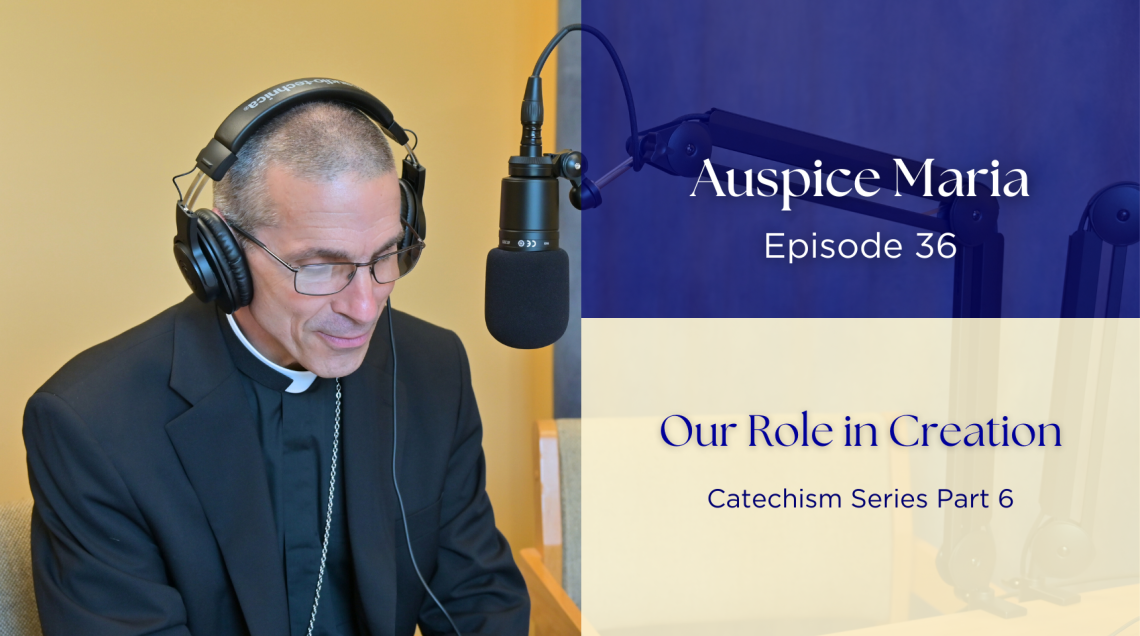
Our Role in Creation (Catechism Series Part 6) - Auspice Maria Ep 36
Follow the Maine Catholic Podcast on:
Transcript:
Well, welcome back to the Auspice Maria podcast. I'm Bishop James Ruggieri of the Diocese of Portland in Maine. And over the past several episodes based on the catechism of the Catholic Church, we've been walking slowly through the first article, the first section of the catechism that is dedicated to the creed. And we have spoken about revelation. We have reflected on faith as the human response to God's initiative. We've contemplated the Trinity, the Father, the Son, and the Holy Spirit and their great mystery. And now we turn today in this episode to creation. And before that, I just want to open up with a prayer as we ask again for the guidance of the Spirit.
Lord, just inspire this podcast and in some way bless those who receive it, who listen to it. Continue to bless all of your creation. Renew the face of the earth. We ask all this through Christ our Lord. Amen.
I simply don't want to move sequentially through the paragraphs of the Catechism that reference creation. Again, we're still in this first part, first pillar of the Catechism based on our faith, the creed. Instead, I want to step back and ask, what kind of world do we live in? What kind of story are we a part of? And the Catechism gives us a really interesting phrase. It says, the universe was created, quote, in a state of journeying, close quote, toward an ultimate perfection yet to be attained, a state of journeying. And that state of journeying is toward an ultimate perfection yet to be attained, a direct reference to paragraph 302, also a reference to paragraph 310.
So basically, creation is not static. It's not finished. It is moving. And so are we. The Catechism names also the questions that every human heart eventually asks. These what we could call perennial questions.“Where do we come from?”
“Where are we going?”
“What is our origin?”
“What is our end?” (CCC 282)
Now, these are not obviously childish questions. They're very serious. And they are perhaps the most adult questions we can ask. They're existential. Science can tell us how the universe is made, basically the elements. However, the catechism, and yes honoring that work, the catechism leads us a little deeper, actually a lot deeper. It says that scientific discoveries should actually lead us to “greater admiration for the greatness of the Creator” (CCC 283).
So science kind of analyzes the elements, the reality of creation, the material matter, the dynamics. But really, our faith leads us beyond creation to a greater admiration for the greatness of our creator. So it leads us from creation to the creator. But science does not answer the deeper question. Why is there something rather than nothing? Why is there order rather than ultimate chaos? And why is there beauty? Why is there love? Why does the human heart long for permanence?
The Christian answer is not simply God made it. The Christian answer is God made it in love, and he made it with a destiny. So when we hear the word creation, some imagine a distant event in the past. But the Catechism insists that creation is ongoing in a profound sense. God does not simply create and leave. The Catechism says, “With creation, God does not abandon his creatures to themselves. He not only gives them being and existence, but also, and at every moment, upholds and sustains them in being” (CCC 301).
That phrase, those two sentences I read, the phrase that stands out at every moment is quite powerful. That means that my existence, your existence right now is not self-generated. It is sustained. The Catechism then describes providence as “the dispositions by which God guides his creation toward” its perfection (CCC 302).
Again, the word that really jumps out, guides, God guides his creation.
History is not drifting aimlessly, haplessly. It's being guided, not manipulated, not coerced, but guided. This means that even when events seem unstable and our own lives feel very fragile, we are not abandoned. The journey has a shepherd.
And now we must ask, who is this God who creates and guides, creates and sustains? Again, the catechism is very clear. The mystery of the Most Holy Trinity is “the central mystery of Christian faith and life” (CCC 234).
Creation is not the work of a solitary power. It is the work of the one God who is Father, Son, and Holy Spirit. The one God who is Father, Son, and Holy Spirit. One God in three persons, this wonderful mystery of our faith, the Holy Trinity.
So the New Testament reveals that God created all things through the Word, the Son, and the Catechism cites St. John and St. Paul. In this line from paragraph 291, “All things were made through him” and “in him all things hold together” (CCC 291; cf. Jn 1:3; Col 1:17). Again, referring to Christ, the divine word, the only begotten son. That phrase, in him all things hold together, is significant.
So it's not markets, economic stock or stock markets, investment markets that hold things together. It's not governments. Stability is not found in algorithms. The Catechism also speaks of the Holy Spirit, so it's Christ through whom all things were made and in whom all things are held together. But also we have to recognize the power of the Spirit. The Catechism speaks of the Holy Spirit as the “giver of life,” the “Creator Spirit,” the “source of every good” (CCC 291).
I'd like to linger here a little bit, because if creation is in a state of journeying, then obviously someone is leading that movement forward. The Father wills it, the Son is the eternal Word through whom all is made. But the Holy Spirit is the one who animates, who breathes, who moves history from within.
The Spirit is not only present at the beginning in Genesis, in the book of Genesis, as we hear, hovering over the waters. The Spirit is present now in the church, in conscience, in sacramental grace, in the quiet movements of conversion, in the courage of the saints. This journey of creation toward fulfillment in a very real way is a Holy Spirit journey. The Spirit is the one who brings what the Father wills and what the Son reveals into lived reality.
Now, about this journey, Catechism does not romanticize it. It says clearly that God freely willed to create a world in a state of journeying, as I mentioned, toward its ultimate perfection. But that means also there is incompleteness, there is growth, there is tension, there is decay and renewal, there is death and resurrection. And there's evil.
The Catechism acknowledges the scandal of evil in paragraph 309. It insists that God is not the cause of moral evil, paragraph 311. It also insists that God permits it because he respects freedom and knows how to bring good from it. A profound, profound reality of our God.
This does not remove the pain of suffering, of course, but it places suffering inside a larger context. Evil does not derail the journey. It does wound, but it does not cancel the destination. And the Holy Spirit continues to work even in broken history, bringing conversion, raising up witnesses, and turning tragedy toward redemption. The cross is the ultimate example. From the greatest moral evil came the greatest good. And so the journey continues.
I'd like to now just talk about a present moment in this journey for us. Artificial intelligence, and you may say, "how are we going from creation to artificial intelligence?"
Well, let's dwell here for a little bit. Artificial intelligence is no longer theoretical. It shapes communication, education, art, economics, and even identity formation.
Now, where does artificial intelligence fit in this journey of creation? The Catechism teaches that God grants human beings the dignity of acting as real causes, real agents cooperating in his providential plan, referring to paragraphs 306 and 307. So what is that saying? It's saying that we are not passive observers. We are actually participants in the becoming of God's creation. And yes, that means technology becomes a part of the journey, and also, importantly, the moral journey.
Pope Leo XIV has addressed artificial intelligence on different occasions in his brief pontificate. He addressed this directly in his address to participants in the International Conference on Artificial Intelligence, which took place in Rome on December 5, 2025. And he said in that address, and I quote, “The ability to access vast amounts of data and information should not be confused with the ability to derive meaning and value from it.”
Now there's quite a distinction that Pope Leo is making. Information is not wisdom. Processing is not discernment. And efficiency is not virtue. So we cannot dismiss the human element in this process of becoming. We cannot leave it to simply machines, but we as human beings have a huge and important role that cannot be replaced, an irreplaceable role in this journeying of creation.
In the same address, Pope Leo said, “Human beings are called to be co-workers in the work of creation, not merely passive consumers of content generated by artificial technology.” And that line really, really echoes paragraph 307.
So artificial intelligence is part of the journey of human culture. But it must remain a tool ordered to the human person. It must never replace moral agency. It must not displace prayer, contemplation, conscience, or relationship. The Holy Spirit is the giver of life. Technology does not give life. It rearranges, processes, researches data. The Spirit forms saints. And artificial intelligence, we could say, forms outputs. And if we lose that distinction, we risk confusing the machine with the meaning.
But if guided by wisdom, indeed, artificial intelligence can assist human flourishing, provided we remember who we are, where we're going, and whose we are, creatures sustained by God and always called to cooperate with him.
Let me again return to the Holy Spirit. Catechism in paragraph 300, citing Acts of the Apostles, chapter 17, verse 28, teaches that God is present to His creatures in most being. “In him we live and move and have our being” (CCC 300, citing Acts 17:28).
So it might sound poetic, but it's more than poetic. It's a truth. The Spirit is active and alive in the sacraments, in the quiet correction of conscience, in the renewal of families, in the courage of young people choosing integrity, in the church's discernment as she faces new ethical questions. The Spirit is not reacting to history. The Spirit is guiding history.
Creation is not simply evolving biologically. It is being drawn spiritually. And the end of that journey is communion, the fullness of life in the Trinity, eternal life.
So, to summarize, creation is in a state of journeying. It's not drifting, it's not abandoned. Man's life is not meaningless. Man is actually an important agent in this process, a contributor. The father wills in love, the son holds all things together, and the spirit moves creation towards fulfillment. Even evil cannot stop the journey. And technological revolutions cannot replace the human vocation. Even uncertainty cannot erase destiny. We are sustained, we are guided, we are called to cooperate in God's divine plan.
At the end of the journey, there is not extinction. The end of the journey is glory. The catechism says that God created the world so that he may become all in all, referencing paragraph 294 and 1 Corinthians 15 verse 28. That is where history is going and that is where the spirit is already leading us.
Thank you for listening today, and I'd like to end again invoking the Holy Spirit, the spouse of Mary, through Mary's intercession as we pray.
Hail Mary, full of grace. The Lord is with thee. Blessed art thou amongst women, and blessed is the fruit of thy womb, Jesus. Holy Mary, Mother of God, pray for us sinners now and at the hour of our death. Amen.