



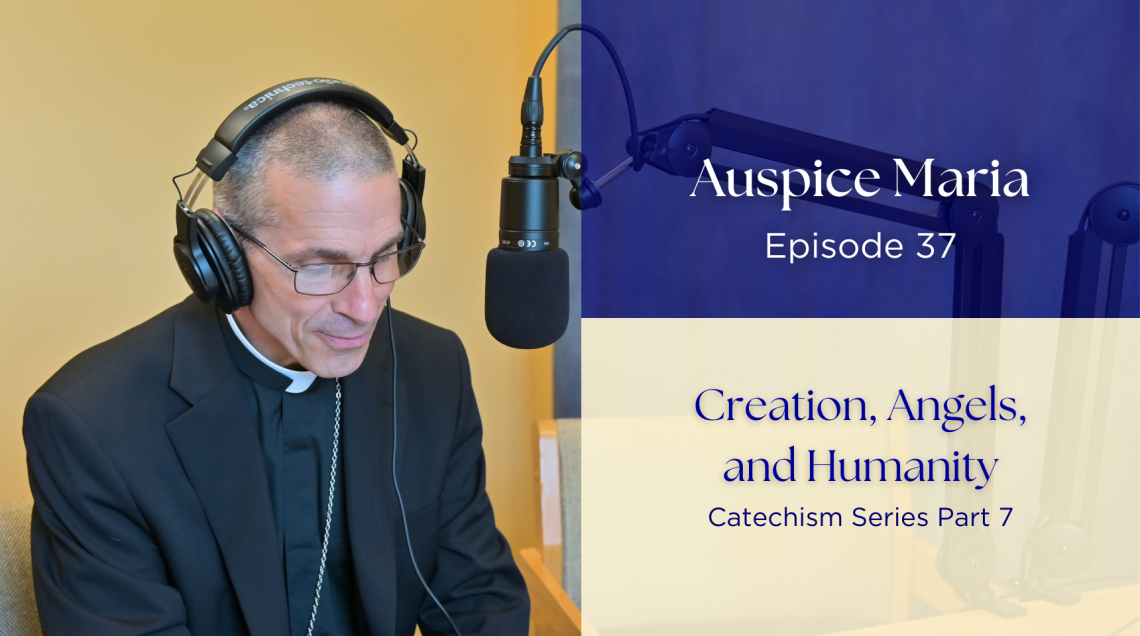
Creation, Angels, and Humanity (Catechism Series Part 7) - Auspice Maria Ep 37
Follow the Maine Catholic Podcast on:
Transcript:
Well, welcome back to the Auspice Maria podcast. I'd like to talk this week about, yes, creation, but also angels and human beings. And as we continue this series on the Catechism, again, always invoking the Holy Spirit's help and guidance and asking that those who are listening may be blessed in some way. So I just want to invoke the Holy Spirit. So Holy Spirit, please help us, open our hearts, inspire us, enlighten us with your wisdom, your knowledge, your understanding, and help us to experience more wonder and awe as we experience the very presence and the creative handiwork of our God around us. And we ask all this through Christ our Lord. Amen.
So recently, as I was driving north on Interstate 95 toward Aroostook County, I experienced one of those moments that really quietly stops you. Now obviously, this is winter, so the leaves were gone. Winter had opened the landscape and, as I came around that familiar stretch of road, Mount Katahdin appeared clearly to the left. And that particular day, the summit was covered with snow. The sky was very, not brilliant, but it allowed the mountain to simply just be so visible and so impressive. Now Mount Katahdin rises 5,269 feet above sea level, and it's the highest peak in Maine and really the northern terminus of the Appalachian Trail. So there's a lot of significance to the mountain.
While it is part of the Longfellow Mountains, in such a way it just stands. The way it stands, it feels so distinct and solitary. It rises with a quiet authority. To me, driving, it seems like it just appears. And so now I know more or less where that appearance happens. And I try to, just without, of course, endangering myself or others on the road, just to be attentive. So I've seen it different times, but that particular day, as I mentioned to you, the snow catching the light, it just sort of looked, again, different, new again. And it reminded me at the same time of how small I am and how beautiful God's creation is.
Whenever I experience something like that, I really find myself asking this question, "This is incredible. We are so blessed. God is so good to us. What does this say? How does this speak to us?"
So really, it's not just one question. It's more of different questions that inspire within me this movement towards God.
Then the Church helps us in some of these questions with a very simple but profound profession of faith. And in that profession of faith, we state very clearly, "God is the creator of heaven and earth, of all that is seen and unseen." That's Catechism reference paragraph 325. So we're declaring that everything that exists, the mountain, the sky, the frozen fields, the forests of Aroostook County, owes its existence to God. Creation is not necessary, is not self-made or self-generated. Creation is a gift.
Now the Catechism reminds us that the visible world and the invisible world are both works of God, the same one God. The mountain that commands our attention and the realities that we cannot see share the same source. In him we live and move and have our being. Catechism paragraph 300. So when I looked at Katahdin that day, I was not just looking at geology. I was looking at something sustained in existence by love. And that recognition leads us naturally to scripture. I'd like to just read for us Psalm 8.
Psalm 8 prays, "Oh Lord, our Lord, how awesome is your name through all the earth. I will sing of your majesty above the heavens with the mouth of babes and infants. You have established a bulwark against your foes to silence enemy and avenger. When I see your heavens, the work of your fingers, the moon and the stars that you set in place, what is man that you are mindful of him? And a son of man that you care for him? Yet you have made him little less than a god, crowned him with glory and honor. You have given him rule over the works of your hands, put all things at his feet, all sheep and oxen, even the beasts of the field, the birds of the air, the fish of the sea, and whatever swims the paths of the seas. O Lord, our Lord, how awesome is your name through all the earth."
Now the psalmist in this beautiful psalm, number eight, looks at the heavens and feels small. He sees the vastness of creation and asks the honest question, what is man? The Hebrew word translated "a God" is Elohim. Now, it's interesting. That can refer to God or to heavenly beings. The ancient Greek translation rendered it as angels, and the church has often received it in that way. Either way, the meaning is astonishing. The human person stands at a threshold between earth and heaven, between dust and glory. The vastness of creation does not diminish human dignity. It really intensifies it. The one who fashioned the stars is mindful of you and me.
So as I continued north, interestingly, as you get into the towns of the north, the forest opened into farmland. Here and there, in the course of the landscape, in the course of the journey, here and there, small cemeteries appeared. Simple gravestones rising through the snow, snow-covered fields, white silence, and the quiet reminder of lives once lived. Now creation is immense, human life is brief, and yet the psalm insists you have crowned him with glory and honor.
The Catechism widens the horizon further. Not only is there a visible creation, but an invisible one. Angels are not myths. They are not poetic symbols. They are not deceased loved ones who have become angels. The Church teaches clearly that angels are real, personal, spiritual beings created by God. That's the reference to the Catechism, paragraphs 328 to 330. Angels possess intellect and will. They are purely spiritual creatures. They do not have bodies as we do. They are not limited by matter. And yet they are not divine. They are creatures sustained by God, ordered to His glory, and involved in His saving work.
From the beginning of scripture to its end, angels appear as messengers, protectors, and servants of the divine plan. They stand before the throne of God. They rejoice at repentance. They strengthen Christ in his agony. They announce the resurrection. And here there's something really consoling. The Church teaches that from its beginning until death, human life is surrounded by the care of angels. Catechism paragraph 336. Each of us is entrusted to a guardian angel. That means you are never spiritually alone, even when you feel alone, even in illness, even in doubt, even in quiet suffering that no one else sees.
Creation is richer than what we see. The visible world is only a part of the story. And then we come to the human person. The Catechism speaks of man as a unity of body and soul, referring to paragraphs 362 to 365. We are not souls trapped in bodies, nor are we merely biological organisms. We are a unity, spiritual and material, standing at the meeting point of heaven and earth. Your body matters. It is not disposable. It is not incidental to who you are. It shapes the dignity of the image of God. And your soul is not a vague spiritual energy. It is the spiritual principle of your personal identity. It is created immediately by God.
The truth has profound pastoral implications. When someone is ill, we do not care only about the body. When someone is grieving, we do not offer only psychological comfort. When someone is struggling morally, we do not reduce it to chemistry or impulse. The human person is always more.
As I drove north further into the county and passed through those snow-covered cemeteries, I thought about the many families who visit those graves, and of course the people buried there. The snow rests gently over the ground. The stones stand quiet and still. Now at death, the soul is separated from the body. That separation is painful because it is not what we were originally created for. We were created for unity, body and soul together. But that separation is not the end. The Church proclaims the resurrection of the body. The same God who sustains Mount Katahdin in existence sustains the human soul beyond death and promises the resurrection of the body in glory. Snow covers the grave, yes, but it does not silence hope.
The catechism also speaks beautifully of man and woman. Male and female, he created them. Also, a direct reference to scripture, the Genesis passage. That's paragraph 369. The difference between man and woman is not an accident. It is part of the wisdom of creation. Man and woman are equal in dignity because both are created in the image of God. They are distinct in their embodiment and they are ordered toward communion. Their complementarity is not competition. It is gift. It is an invitation to communion that mirrors something of God's own relational life.
And in the beginning, humanity was created in a state of original holiness and justice, referencing paragraphs 374 to 376. There was harmony within the human heart, no division within the self. There was harmony between man and woman, no domination. There was harmony with creation, no fear. And ultimately, there was harmony with God, no separation.
Now imagine walking through the forests of northern Maine with no anxiety, no suspicion, no sense of threat. Imagine relationships free of rivalry. Imagine a heart no longer divided within itself. That was the beginning. And though sin has wounded that harmony, it has not erased the dignity of the human person, nor has it erased the promise of restoration.
So let's return once more to the mountain. Creation is vast, it evokes awe. But its greatest proclamation is not simply that God is powerful. It does proclaim that God is generous. He created the heavens and the earth. He created angels to worship Him. He created humanity, body, and soul, crowned with glory. He created man and woman for communion. He created us in holiness. And even after sin disrupted that original harmony, He did not abandon us.
From the moment of conception to natural death, every human life bears the imprint of divine intention. The dignity of the human person does not depend on productivity, recognition, or health. It rests on creation itself. And the hope of eternal life is not vague optimism. It is the restoration and fulfillment that was always intended. The recovery of holiness, the healing of division, the reunion of body and soul, the vision of God.
So as vast as Mount Katahdin is, as wide as the Maine sky, as deep as winter silence, God's love is deeper still. What is man that you are mindful of him? You are mindful of him because you made him, O Lord. You are mindful of her because you love her, O Lord. You are mindful of us because we are yours, O Lord. O Lord, our Lord, how awesome is your name through all the earth.
Thank you for joining me today as we continue this series on the Catechism. I'm Bishop James Rajiri of the Diocese of Portland in Maine. I'd like to just end with a Hail Mary asking our Blessed Mother to intercede for us all as we pray. Hail Mary, full of grace, the Lord is with thee. Blessed art thou amongst women and blessed is the fruit of thy womb, Jesus. Holy Mary, Mother of God, pray for us sinners now and at the hour of our death. Amen.