


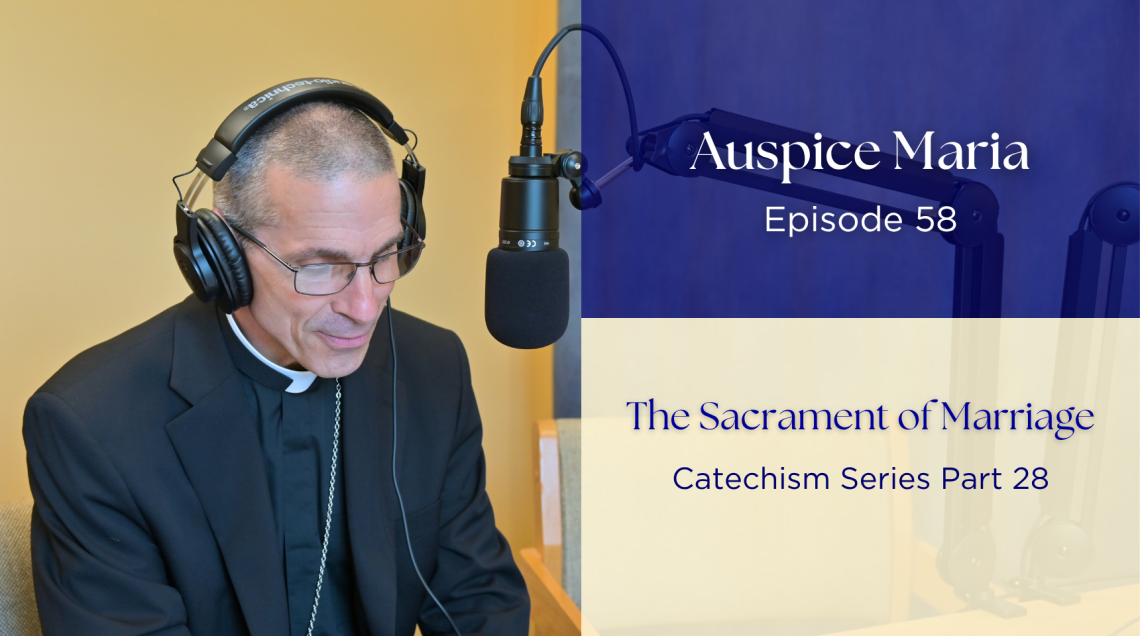
The Sacrament of Marriage (Catechism Series Part 28) - Auspice Maria Ep 58
Follow the Maine Catholic Podcast on:
Transcript:
Welcome back to the Auspice Maria podcast. I'm Bishop James Ruggieri of the Diocese of Portland in Maine, and we continue our series on the Catechism. We're finishing up the sacraments. This is the last of the seven sacraments: Holy Matrimony. And I'd like to begin, of course, by invoking the Holy Spirit, asking the Spirit to guide and to direct this podcast, and also to help those who listen to just be open to the promptings of the Spirit and the movement of the Spirit. May all be blessed.
So, Lord God, pour out your Spirit upon us. Continue to move us along these paths of holiness according to our states of life, and may we rely more and more on your grace. We ask all this through Christ our Lord. Amen.
So we come in this episode to the last of the seven sacraments, the Sacrament of Matrimony. We are still in Part Two of the Catechism of the Catholic Church, "The Celebration of the Christian Mystery." We are in Section Two, "The Seven Sacraments of the Church." We are in Chapter Three, "The Sacraments at the Service of Communion." We have already considered Holy Orders, and now we turn to Matrimony, and these will be paragraphs 1,601 to 1,666.
So Holy Orders and Matrimony are called sacraments at the service of communion because they are ordered toward the salvation of others. In marriage, a man and a woman are not turned inward upon themselves. Their covenant becomes a service to each other, to their children, to the Church, and to society. Christian marriage is personal, but never merely private. It is a vocation. It is a mission. It is a way of holiness.
And the Catechism begins with a definition: "The matrimonial covenant, by which a man and a woman establish between themselves a partnership of the whole of life, is by its nature ordered toward the good of the spouses and the procreation and education of offspring." And it states, going on, "between baptized persons has been raised by Christ the Lord to the dignity of a sacrament." So that is taken from paragraph 1601, and it cites the Code of Canon Law, Canon number 1055, paragraph one. Sort of getting to the essence of the marriage covenant — what it is, and the goods of it.
So let's talk a little bit about marriage in relationship to creation. Before it is a sacrament, marriage is already a part of God's plan for humanity. The Catechism reminds us that "the Sacred Scripture begins with the creation of man and woman in the image and likeness of God and ends with the vision of the wedding feast of the Lamb." That's from paragraph 1602. So from the beginning, marriage speaks of communion, fruitfulness, and divine love.
God creates man and woman with equal dignity and real complementarity. The woman is not beneath the man; she is his counterpart — different but equal, his nearest companion. Genesis says, in chapter two, verse 18, "It is not good for the man to be alone." So the man and the woman are created for communion. Their love is meant to be faithful, fruitful, and ordered toward life.
And the Catechism, citing the Vatican document Gaudium et Spes, on the Church's relationship to the world, section 48, teaches that "God himself is the author of marriage." Now, this means marriage is not simply a social arrangement invented by human beings. It is rooted in the nature of the human person as created by God. Again, we see marriage found in nature, in God's creation. The union of husband and wife reflects something of God's own faithful love. As the Catechism says, "since God created humanity male and female, their mutual love becomes an image of the absolute and unfailing love with which God loves man," from paragraph 1604.
But marriage, like all human life, is wounded by sin. The relationship between man and woman can be threatened by discord, domination, infidelity, jealousy, selfishness, and separation. Those are some things mentioned in paragraph 1606. And in 1607 it says, very importantly, "the disorder does not come from marriage itself, but from sin." That's important, because what God makes is good. Marriage is a part of God's creation. It is good. So the disorder does not come from marriage itself. It is not innately flawed, but really comes from sin.
And this is important pastorally. The Church does not speak about marriage naively. She knows that marriage requires grace, patience, conversion, forgiveness, resilience, and perseverance.
Now let's look to the New Testament, let's look to Jesus. Jesus raises marriage to the dignity of a sacrament. At Cana, Jesus performs his first sign at a wedding feast. And it's significant — we find this in John's Gospel. The Church sees in his presence there at the wedding feast of Cana "the confirmation of the goodness of marriage and the proclamation that marriage will become an efficacious sign of God's presence," paragraph 1613.
So Jesus also recalls the original plan of the Creator. This is in Matthew 19, verse 6. He says very clearly in Matthew, "What God has joined together, no human being must separate." Now, listening to this, it might sound demanding, especially for those maybe who are struggling right now in their marriage. The Catechism acknowledges that "the Lord's insistence on indissolubility may seem difficult, even impossible," but Jesus does not place an impossible burden on spouses. "By restoring the original order of creation disturbed by sin, he gives the grace to live marriage in the new dimension of the Kingdom of God," paragraph 1615.
So Christian marriage is not simply a human promise supported by human strength. It is a covenant strengthened by Christ. And St. Paul expresses this mystery by comparing the love of husband and wife to the love of Christ and his Church. These are some famous lines from Ephesians, Ephesians 5, verse 25, and also bringing in verse 32. We find this in paragraph 1616 in the Catechism. Again, the words of St. Paul from Ephesians: "Husbands, love your wives as Christ loved the Church." And he goes on, "this is a great mystery, but I speak in reference to Christ and the Church."
So in matrimony, the love of husband and wife becomes a sacramental sign of Christ's faithful, fruitful, and irrevocable love for his Church.
Well, let's look now at how marriage is celebrated, as we continue again through the section of the Catechism, and what makes a valid marriage — a very important question. The Catechism teaches that in the Latin Church, the spouses are understood to be the ministers of the sacrament. That might sound surprising. Sometimes we think the priest or the deacon officiant is the minister, but in the Latin Church, the Western Roman Catholic Church, the spouses are understood to be the ministers of the sacrament. "They confer matrimony on each other by expressing their consent before the Church. The priest or the deacon receives their consent in the name of the Church and gives the blessing of the Church," paragraphs 1623 and 1630.
So as we delve more deeply into this, consent is essential. The Catechism says the exchange of consent — this is the part of the marriage promise, the "I do's" — the Catechism says the exchange of consent is the indispensable element that, quote, "makes the marriage." That's paragraph 1626. So consent means that a man and a woman free to marry give themselves to each other mutually and definitively in a covenant of faithful and fruitful love. If consent is lacking, there is no marriage. So if there's force or fear involved in the exchange of consent, or the promise or threat, it's not a valid marriage. Consent must be free.
So from a valid marriage arises a bond between the spouses. And the Catechism teaches that "this bond is established by God himself, so that a marriage concluded and consummated between baptized persons can never be dissolved." That's paragraph 1640. "In Christian marriage, the spouses themselves are strengthened, and, as it were, consecrated by a special sacrament for the duties and dignity of their state," paragraph 1638.
So this is why the Church treats marriage with such reverence. The bond is not merely emotional, legal, or social. It is a covenantal reality grounded in God's fidelity.
I'd like to look now at conjugal love, the gift of children, and the domestic church. And there's a beautiful paragraph, 1643, that talks about conjugal love, the love between the spouses. And it's really a direct quote from the document on the family by St. John Paul II, Familiaris Consortio, section 13. And in this paragraph of the Catechism, it teaches that conjugal love "involves the whole person." It is not only attraction or feeling, although of course those are present. It is a deeply personal unity of body, heart, spirit, and will. You can see, involving the whole person. It demands faithfulness, indissolubility, and definitive mutual giving, and it is open to fertility, open to life. So the goods of marriage include the good of the spouses, again, and the procreation and education of children.
So in Christian marriage, Christ dwells with the spouses. He gives them strength to take up their crosses, rise after they have fallen, forgive one another, bear one another's burdens, and love with a supernatural, tender, and fruitful love. Christ's grace makes this all possible. This is one of the most consoling truths about marriage. The sacrament does not remove every difficulty. It gives grace within the difficulty.
Marriage is also ordered toward the gift of children. Children are not accessories to marriage. They are a supreme gift entrusted to the love and responsibility of their parents. Parents are the first educators of their children in faith, prayer, virtue, and love.
The family becomes what the Church calls the domestic church. And the Catechism says that the Christian home is, quote, "a community of grace and prayer, a school of human virtues, and of Christian charity." That's from paragraph 1666. Beautiful image of the Christian home — a community of grace and prayer, a school of human virtues and of Christian charity. So this means that family life is not outside the Church's mission. It is one of the first places where the Gospel is lived. Around the table, at bedtime prayers, and forgiveness after conflict, in care for aging parents, in welcoming life, in teaching children to pray, in Sunday Mass, in sacrifices made quietly every day — the family becomes what it is called to be, what it is made to be: a living cell of the Church.
Finally, I just would like to offer a few pastoral words, if you're listening to this podcast and maybe it's stirring up some things or causing you to think about some things. I'd like to talk about those who are married — I'd like to talk first to those who are married, and of course, to thank you. The Church thanks you. Your fidelity matters. Your daily sacrifices matter. Your love teaches the Church something about Christ's love.
So do not try to live marriage without grace. Just some hopeful advice, or things to ponder, something to ponder: do not try to live marriage without grace. Please, spouses, pray together. Come to Mass together. Go to confession. Work at forgiveness. Ask for help when you need it. And of course, let Christ dwell in your home.
To those who are single, you are not outside the family of the Church. The Catechism says that many single persons, sometimes through circumstances not of their own choosing, are, and I quote, "especially close to Jesus' heart," and "deserve the special affection and active concern of the Church." It's from paragraph 1658. So again, if you're single listening to this, and maybe it wasn't necessarily your calling or choice to be single, please know that you are not outside of the family of the Church. Really, every Christian life has dignity — it's so important. A mission and a call to holiness — we are called to live it differently. We're called to live this universal call to holiness differently. But again, those who are single, please know that you are especially close to Jesus' heart, and you deserve the special affection and active concern of the Church. You're very important to the Church and to the life of the Church.
To those who are divorced, the Church sees your suffering. Divorce often brings grief, a sense of failure, abandonment, and wounds that remain possibly for years. A divorced person who has not attempted a new union is not separated from the sacrament simply by being divorced. The Church wants to accompany you with truth and mercy.
To those who are divorced and civilly remarried without a declaration of nullity, the Church's teaching is lovingly clear and truthful, because marriage, of course, is covenantal — it's serious. If the first marriage was valid, a new union cannot be recognized as valid. I'm referring to paragraph 1650. Now, at the same time, you are not rejected by the Church. The Catechism teaches that such persons, divorced and remarried persons, "are not separated from the Church" and are called to Christian life, especially by educating their children in the faith.
I would like to quote the Catechism directly here, offering counsel to those who are divorced and have remarried civilly without a declaration of nullity regarding their valid marriage. And again, I'm referring to paragraph 1650. Regarding those who are civilly divorced and remarried, as often will be said outside of the Church, the Catechism says, "consequently, they cannot receive Eucharistic communion as long as this situation persists. For the same reason, they cannot exercise certain ecclesial responsibilities. Reconciliation through the sacrament of penance can be granted only to those who are committed to living in complete continence" — and that is abstinence from marital relations.
So that's the quote from paragraph 1650, but really my advice to those in these circumstances is to, if you haven't already, is to really speak with a priest for clarity, especially regarding what's possible — the annulment process, what is that, what does that involve? Please speak to a priest. I wouldn't presume what you maybe read on social media or through Google searches is accurate, is really solid advice. Please allow the Church to walk with you.
Regarding a declaration of nullity — a declaration of nullity, often called an annulment, is not a Catholic divorce. It is a judgment by the Church, after very careful examination, that a valid marriage bond was not present from the beginning. It's from paragraph 1629. So this annulment process is meant to serve truth, healing, and the good of souls.
So as we conclude this episode, and this journey through the seven sacraments, we conclude today with the Sacrament of Matrimony. I invite us all who are listening to please let's pray for married couples. Let's pray for engaged couples preparing for marriage. Let us pray for families under pressure. Let us pray for those who long for marriage, for those whose marriages have suffered, and for those who carry wounds from divorce. And let us ask the Lord to renew in the Church a deeper reverence for holy matrimony.
Marriage is a gift of creation, and between the baptized, a sacrament of the New Covenant. In the faithful love of husband and wife, Christ continues to show his faithful love for the Church. And in the Christian home, the Gospel is handed on, love is learned, mercy is practiced, and the Church is built up from within.
Thank you so much for listening, and I'd like to conclude by again offering a Hail Mary, asking our Blessed Mother Mary to intercede for us as we pray together. Hail Mary, full of grace, the Lord is with thee. Blessed art thou amongst women, and blessed is the fruit of thy womb, Jesus. Holy Mary, Mother of God, pray for us sinners now and at the hour of our death. Amen.