


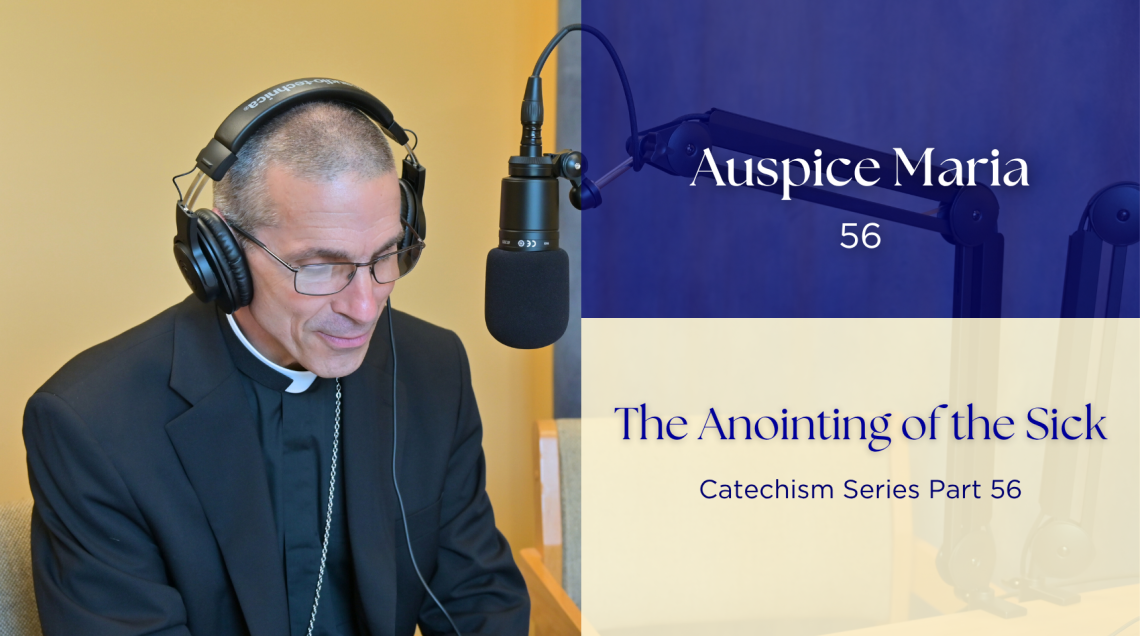
The Anointing of the Sick (Catechism Series Part 26) Auspice Maria Ep 56
Follow the Maine Catholic Podcast on:
Transcript:
Welcome to the Auspice Maria podcast. I'm Bishop James Ruggieri of the Diocese of Portland in Maine, and this week we'll be talking about the second sacrament of healing, the anointing of the sick.
Before doing so, though, of course, we just want to open up our podcast with a prayer to the Holy Spirit in gratitude for the Spirit's presence among us, for the Spirit's activity in the Church today, for the comfort the Spirit brings to those who are sick, struggling with illness. We pray: "Come, Holy Spirit, fill the hearts of your faithful, and kindle in them the fire of your love. Send forth your Spirit, and we shall be created, and you shall renew the face of the earth." Amen.
In the last episode we reflected on the sacrament of healing, of reconciliation, known as the sacrament of penance, where Christ meets the sinner with mercy and restores communion with God and the Church. Now we turn to the second sacrament of healing, the anointing of the sick.
We're still in Part 2, Section 2, Chapter 2, Article 5 of the Catechism of the Catholic Church. The paragraphs for this episode are 1499 to 1532.
And the Catechism begins this section with a sentence that really gives us the heart of the sacrament of anointing. And I quote: "By the sacred anointing of the sick and the prayer of the priests, the whole Church commends those who are ill to the suffering and glorified Lord." That's from paragraph 1499, and it's a citation directly from Lumen Gentium, section 11. That's that great Vatican II document, the Constitution on the Church. So basically, we start off by hearing the sick are not forgotten. They are not outside of the Church's life. They are entrusted to Christ, who suffered, died, and rose.
I'd like to first begin with Jesus and the Gospels before we delve into some of the essentials of the sacrament. When we read the Gospels, we see Jesus continually drawing near to suffering people. The blind call out to him, lepers approach him, the paralyzed are carried to him, parents bring sick children to him, people who have been pushed to the margins find in Jesus someone who sees them, who touches them, and restores them.
Mark, chapter 1, gives us a quiet but very beautiful example. Jesus enters the house of Simon and Andrew, and Simon Peter's mother-in-law, is sick with a fever. They tell Jesus about her, he approaches, grasps her hand, and he helps her up. And we are told the fever leaves her and she begins to serve them. It's Mark, chapter 1, verses 29 to 31.
Hopefully, even if you go back and read it, you notice the tenderness of the scene. Jesus does not heal from a distance. He draws close. He takes her hand. He raises her up. Her healing restores her not only to physical strength, but also, beautifully, to the household. She becomes, once again, an active part of the household, and in a greater sense, to the community, and she serves.
This is what the healings of Jesus reveal. They are not only miracles of physical restoration, though they are truly that. They are signs that the kingdom of God has come near, is here, and is growing in our midst. The Catechism teaches that Christ's compassion toward the sick and his many healings are a sign that "God has visited his people" and that "the kingdom of God is close at hand." Catechism, paragraph 1503. Jesus heals the whole person, soul and body. He is the divine physician.
And paragraph 1505 takes us still deeper. The Catechism says here: "Moved by so much suffering, Christ not only allows himself to be touched by the sick, but he makes their miseries his own." Then the Catechism recalls the words of the prophet Isaiah, fulfilled in Jesus. And the quote from Isaiah is: "He took our infirmities and he bore our diseases." That's cited in Matthew, chapter 8, verse 17, and also comes from Isaiah the prophet, chapter 53, verse 4.
And I think this is very important to recognize: Jesus does not merely observe suffering. He enters it, he carries it, he transforms it from within. The Gospels do not promise that every disease will disappear immediately. Even during his earthly ministry, Jesus did not heal every sick person, but his healings announce a greater victory through his cross and resurrection. Christ conquers sin and death, the deepest wounds of the human condition. Again, reference to paragraph 1505.
I'd like us now to consider illness in the light of the Paschal Mystery — the great life, death, resurrection, and ascension of Jesus. Illness can be one of the most difficult experiences in human life. It brings fear, loneliness, dependence, frustration, and even anger with God. The Catechism speaks honestly about this. From paragraph 1501, it talks about how illness can lead to anguish, self-absorption, sometimes even despair and revolt against God. But I think also — and this is the same paragraph — it can also make a person more mature, can help him discern what is not essential, and even, in many cases, turn people back to God.
The Christian faith does not pretend that sickness is easy. It does not romanticize suffering. Illness remains part of the world's wounded condition. Jesus himself, we must recall, in John's Gospel, he wept at the tomb of his friend Lazarus. He had compassion for the suffering, he confronted sickness and death, and entered the brokenness for which he came to save us.
At the same time, Christ changes the meaning of suffering. By his passion and death on the cross and his resurrection, suffering can now be united to him. And this is important because, again, it gives suffering meaning. The Catechism says that suffering can "configure us to Him and unite us with His redemptive passion." Again, from paragraph 1505.
This does not mean that suffering saves apart from Jesus. It means that suffering, when joined to Jesus, need not be meaningless. The sick person can share in the mystery of the Lord's self-giving love.
This is why the anointing of the sick is not a sacrament of abandonment. It is not a sign that hope is over. It is a sacrament of Christ's nearness. It says to the sick person: the Church is with you, Christ is with you. Your suffering, your fear, your weakness, and your prayer can be placed in the hands of the suffering and glorified Lord.
Let's talk now about who should receive the sacrament and how it is celebrated. The Catechism is very clear, from paragraph 1514, and this is also a direct citation of Sacrosanctum Concilium — that's the great Constitution on the Liturgy of the Vatican II council. It says: "The anointing of the sick is not a sacrament for those only who are at the point of death." Very important — it is not only for those who are at the point of death. It is fitting to receive it when one of the faithful begins to be in danger because of sickness or old age.
And this is pastorally important. Families ought not wait until the final moments for a loved one to be anointed if that loved one is seriously ill. I would suggest, and I think any priest would suggest, please call the priest earlier. Let the sick person be strengthened by the grace of the sacrament. If the person is conscious, even better that the person can participate in the rite of anointing and can experience that reality of being surrounded in prayer.
The sacrament may be repeated if the person recovers and later becomes seriously ill again, or if the same illness worsens. It is also fitting before a serious operation for a person to be anointed, and for elderly persons whose frailty becomes more pronounced. Again, the sacrament can be repeated, it is not simply once and that is all.
Only bishops and priests are ministers of the anointing of the sick, and the celebration includes the prayer of the priest, laying on of hands, and anointing with blessed oil. Oftentimes that oil is blessed by the bishop along with the other oils, the oil of catechumens and the chrism oil, at the Chrism Mass. In the Roman Rite, the priest anoints the forehead and the hands of the sick person, praying that through this holy anointing the Lord in his love and mercy may help the sick person with the grace of the Holy Spirit. When possible, this sacrament may be preceded by confession and followed by the Eucharist. It's from paragraph 1517. And this beautifully demonstrates the Church's care for the whole self and the tenderness of the Church's care, mercy for sin, strength in sickness, and communion with Christ.
What are the effects of the sacrament? The Catechism says that the first grace of the sacrament is "strengthening, peace, and courage." That's from paragraph 1520. And that may be exactly what a sick person needs most — not easy answers, because sometimes there are no answers to sickness, but strength; not isolation, but peace; not despair, but courage and hope.
The sacrament may also bring healing of the body, if such is God's will, and it brings, really, healing of the soul — that's a fruit of every anointing. The Catechism also teaches that through the holy anointing, if a person has committed sins, he will be forgiven. It's a reference to the Letter of James, chapter 5, verse 15. It's paragraph 1520. Now, please note that this does not replace ordinary confession when confession is possible, but it shows the sacrament's merciful power. And often, if a person is alert and conscious, the priest who is administering the sacrament of anointing will ask the person, before administering the sacrament of anointing, if he or she wants to go to confession. And those can be such, such beautiful moments — moments of great healing for people, and acceptance, when that sacrament of confession is offered along with the sacrament of anointing.
Anointing also unites the sick person more closely to the passion of Jesus Christ. By the grace of this sacrament, the sick person receives the strength and gift of uniting himself more closely to Christ's passion, from paragraph 1521. And this is part of that whole reality of giving suffering new meaning when it's united to the passion of Christ.
And hopefully it conveys to the sick person that he or she is not useless. I think sometimes we struggle with that when we have illnesses, or because of old age and frailty we feel we just can't do anything anymore. Quite the contrary. I've heard this, and I love this expression: we are human beings. Our dignity exists, or is a reality, because of who we are — our existence given to us by God. We are not human doings; doing things does not simply make us valuable. No, to the contrary, who we are makes us valuable.
So I think we are susceptible at times, though, when we are ill or frail and we can't do what we used to do, to think, "Oh, I'm just useless." Quite the contrary — the sick person is not useless. He or she remains a living member of the body of Christ. Prayer, patience, trust, and even weakness can become a hidden offering for the Church and the world.
The sacrament also has an ecclesial grace. The Catechism talks about this ecclesial grace: the Church intercedes for the sick person, and the sick person contributes to the sanctification of the Church. This is a necessary reminder that the sick are not simply people to whom the Church ministers, they are also members through whom the Church is sanctified.
And finally, when a person is approaching death, anointing prepares the soul for the final journey. And the Catechism says that the sacrament "completes the holy anointings that began with baptism and confirmation, and fortifies the end of earthly life before entering the Father's house." Beautiful, beautiful realities and imagery. It's from paragraph 1523. Along with anointing, the Church offers viaticum — the Eucharist received as food for the passage from this life to the Father, food for the journey, usually the last time a person receives Holy Communion.
So this sacrament, anointing of the sick, should not be feared. Calling the priest is not giving up. It is an act of faith. It is allowing Christ and His Church to draw near. So, if you are sick, please know the Lord sees you. If you are caring for someone who is sick, your love matters deeply. If someone you love is seriously ill, please do not hesitate to call your parish priest. If you are afraid of death, remember that Christ has entered death before us and opened the way to life.
In the anointing of the sick, Christ still comes close. He still takes the suffering person by the hand. He still strengthens, forgives, consoles, and raises up. The sacrament does not remove every mystery from suffering, but it reveals the deepest truth within it: in sickness and in health, in weakness and in dying, the suffering and glorified Lord remains near to His people.
Thank you for joining me again on the Auspice Maria podcast. I'd like to conclude simply by asking Our Lady, Mary, Help of the Sick, to pray for us.
Hail Mary, full of grace, the Lord is with thee. Blessed art thou amongst women, and blessed is the fruit of thy womb, Jesus. Holy Mary, Mother of God, pray for us sinners now and at the hour of our death. Amen.